; Cwyn's Death By Tea: Factory Teas ;
Showing posts with label Factory Teas. Show all posts

Monday, March 29, 2021

Bad Connection


Been three years now since the ex-husband moved to China and we got a divorce over Skype. That first year he lived in Hefei, so before he left I made sure he tried plenty of Anhui heicha just to prepare, but then he drank zero tea the entire time he lived there. To be fair, the smog got awfully bad that year in Hefei and he stayed indoors much of the time. The next year he moved to Shanghai where the tea scene is better, and I gave him some emails for tea people to meet for dinner and tea shopping. But then the Coronavirus arrived, and he again spent much of his time in his apartment . When things opened back up again he preferred to go to Disneyland rather than follow up on the tea leads I provided.  

Last fall he moved again, this time to guess where, Guangzhou in Guangdong Province. Yes, the home of Guangdong storage where puerh tea ages nicely whilst retaining its integrity. He doesn't have coronavirus restrictions to keep him home, and he is out and about daily in Guangzhou and could be spending his considerable free time scouting the tea scene. Now I am not entirely self-centered in my endeavors to provide him with connections of tea collectors and vendors to meet with. In fact, I have told him not to buy me any tea. 

The ex is constantly complaining about money, even though he has a pension, teaching pay and gets free housing from his employer. Tea could provide a lucrative side hustle. Especially because now we have so many people looking for cheap factory teas. Yet another vendor option in Guangzhou willing to slap on a shipping label to the west could make some nice cash. I am thinking in particular of his live-in girlfriend who is of course unemployed. I am uncertain if she speaks Cantonese but with all the free time she has I am certain she can learn. 

"Amy is busy, she is doing lots of painting of oil and pastels." He objects. 

Of course Amy is not her real name. I don't think he knows her real name. 

"Her style at the moment is like Modigliani. We plan to be like starving artists."

"So what will she do after you leave China in two years?" I wonder. 

Crickets. Bad connection. I message him that nobody has taken his 88 year old mother for a vaccine. More crickets.

Naturally it's a big fat nothing again when tea friends of mine offer to take him (and her) out for dim sum, and he doesn't bother to answer the invitation from them. Meanwhile the money situation is getting serious. He misses two car payments for the car he owns currently residing in my driveway, which I was forced to take for storage by the divorce judge. 

I send him a screenshot of the 2021 7542 sold by the competition. 


You read that right, $319 and change.

"Look at this, you find a few of these to sell, even a hundred bucks less and you're still making money. All you have to do is find anything Taetea, in any condition and we've got a market here. I can set you up with plenty of buyers." Even the hurricane/flood-destroyed tea must be cheap and people will surely think it tastes like Hong Kong stored.

"I've seen TV commercials for Taetea," he says. "They seem like a huge company."

"They’re like the Oscar Meyer of wieners." 

My ex used to live just across from the Oscar Meyer plant in Madison. 

Joshua Rainey Photography, Shutterstock

"Ew." 

Oscar Meyer occasionally leaked waste water into Lake Mendota and globs of meat fat rolled up on the beaches. 

"You don't have to drink the tea," I say. "I certainly wouldn't. The important part is the wrapper, people want the Chinese wrapper more than the tea in some cases."

I start to explain about the stickers and needing to buy a black light but his VPN disconnects.. 

Next I see on Facebook he spent money on a computerized sound board. "I'm starting a career in writing film music, I met a local actor in the movie business." He posts.

Another payment notice arrives in the mail for the car. I email reminding him about Taetea.

Just imagine yourself in this situation, you are a puerh head, right? Otherwise you would not be here reading this. Imagine you have someone in your life that you have known for more than thirty years who is now in Guangzhou. More than that, you have a child with this person. A grown child, even. Can you think of any better connection to the puerh world than this? He has an unemployed girlfriend who speaks the language. Well, one language anyway. Could be two if she applied herself. But of course they need money to start up considering expenses like: 

ex's expenses

Yes. Coffee. He goes out for coffee in Guangzhou. Probably like most everyone else. Are we seeing a pattern here? What are the chances he does anything related to tea?

"TaeTea is a company like Starbucks," I email. Starbucks is heavily invested in Yunnan. Look it up. 

"You said it's like Oscar Meyer wieners."

"Okay yes, nobody here who drinks factory tea eats Oscar Meyer. They probably eat Tofu Pups from Whole Foods, but for some reason huge factory is okay when it has a Chinese wrapper. Look I can't explain it, but do you guys want a decent side hustle or not? I'll put up the money to get started but not for the car."

He calls on Skype. 

"I don't know about the tea thing, but I could use the money. We are looking to book a house for the summer in Kunming."

Of course he is. 


Thursday, February 18, 2021

1997 Menghai Shui Lan Yin "Water-Blue Stamp"


Recently I ordered a sample of this 1997 Menghai Shui Lan Yin tea from Houde Fine Tea. Most puerh drinkers online recognize this Houston-based tea vendor who has been selling from a personal collection teashop for well over a decade now. Houde is one of the few vendors back in the oughts selling well-known factory and Taiwan boutique teas from a US location, well covered in puerh blogs. This is the first tea I have tried from Houde. In years past whenever new Houde teas got posted, selections of any interest to me sold out immediately. I do have another factory beeng from Houde in my collection, but it is much younger and I have not tried it because it needs more aging. 

I keep thinking of Houde today though because of the catastrophic weather disaster occurring in Houston, Texas and all over this state. Texas is undergoing an extended period of bitter cold temperatures for which homes and state infrastructure are woefully unprepared. The temps have fallen below -10C at night for more than a week now, with snow and ice storm events. Homes are not equipped for these kinds of temperatures and people are dealing with loss of electricity, heating and water. Houston is currently struggling to keep electricity on and is under a boil water order. Water pipes are likely frozen and burst in homes. Unlike up north where I live, Texas houses have water pipes running along the outside of the home because the weather rarely gets cold enough for them to freeze. Fireplaces and wood stoves are not common in Texas, leaving people with few heating options when the power grid is out.


It is difficult to overstate the human tragedy that is happening. We do not know the scope of this yet. I expect that more loss of life will be found in coming days. Food and water shortages are common. Stores are running out of food and trucks cannot get food delivered because the state roads are snow and ice covered. Farmers are dumping milk they cannot deliver to dairy. Farm animals are dead or at risk of running out of feed. Vegetable and fruit crops are lost. Restaurants are closed or limited because of no water and food deliveries. I have two friends in Houston that I have been unable to get news of. 

Houde has stored his tea collection in an outdoor garage. Normally the warm and humid Texas weather provides ideal puerh storage conditions. I am guessing the tea had to be moved into a house to avoid freezing, but then when the power went out in Houston, keeping tea warm is not a priority or even a possibility. One can only hope Houde and his family are getting by at home, or at a hotel, or have left the state for a time as some people have done. My understanding today is that power has been restored to most people in the Houston area, but the city is still under a boil water order and the power grid is still fragile state-wide. I would guess the food and water shortages are daily life here as well. If Houde is still at home, he has much to deal with just with daily living. 

After this event ends, no doubt he will evaluate the state of his tea collection. One favorable side to his collection is the number of aged teas which, if dry enough, might be okay. Another favorable aspect is the durability of heavily compressed teas like iron-pressings, tuos or bricks, these tend to survive weather events very well. The biggest risk to tea along with the cold is condensation from thawing temperatures. That is aside from any water issues in the home. Of course a tea collection fades in importance to family and home, yet a collection is an investment one might turn to in times when home repairs need funds. I hope we are all ready to buy up some tea if we see any posted in coming days. Right now any teas ordered from Houde are likely to need understanding for delayed shipping. I am not sure of the state of postal services, trucking and flights from Texas.


This 1997 Menghai Shui Lan Yin is a rather famous tea in collector circles. Houde provided an auction link along with his photos, I am unsure if this is provided for information or if he bought the tea from this auction because he does not say how he came to acquire the tea or how long he has owned it. Many of his other teas came from trips to Taiwan. Unfortunately I don't see a photo of the full open beeng on the listing. An important fact about this tea is that few examples of it exist, and it is very likely that the few that surface such as at the 2019 auction are coming from Hong Kong provenance. He had 7 packages of 15g samples to sell for $90 apiece. This puts the full beeng price at $2142 or $6/g. I wish the photos had included full pics of the open uncut beeng, but the close ups are nice.

I bought my sample and noticed one other sample had sold the same day. Then the remaining five samples sat for a couple of weeks, and then only in the past few days I noticed the rest had sold. I don't know if it will be restocked.

I decided that given the cost of the tea, I would brew in 3g increments, which is not my ideal ratio. I often feel I cannot get a full taste of the tea brewing less than 5g even when I keep the water proportionate. The tea does not have the fullest flavor and it cashes out quickly just brewing a few grams. But I can at least get some idea of the tea and brew more later.

While getting the tea ready to brew, I had the chunk photo done and was busy pouring out a rinse when the phone rang. A friend from the Midland area of western Texas called up. We have been talking daily. He lives by himself in an apartment building and is dealing with all of the issues I wrote above like other Texans. Over the phone we decided to complete a food stamps application for him together, and I drank the tea while working on the application and talking on the phone. Consequently I lost track of the number of steeps. 


I noticed the tea has a very nice aged aroma of traditional storage, in that the storage has been done some time ago and now smells earthy and basement-like, but not moldy in any way. The tea has what I would consider a well-done Hong Kong type profile, the leaves are definitely of an older tea in that they are thicker and more plushy than the thin tissue paper-like plantation factory leaves we see nowadays. 

The brew is very warming and brandy-ish brewed in a Ruyao glaze gaiwan. Next time I will brew in clay to mitigate the storage some. The tea has a tangy fruit profile and a mineral finish, unfortunately heavily affected by the wet storage which has mostly obliterated the tea. If you like this type of storage, you will find the tea very pleasant. The caffeine level is still high, the qi is moderately good with some facial numbing and body warming. I get a nice sweetness on the back of the tongue. The tea shows some green yet in the leaves but has no remaining bitterness.


I just kept pouring out the brews while talking with my friend and working on the application. I know I pushed well past 10 steepings just out of the 3g of leaf which is impressive. The tea is pleasant enough but the storage does not dissipate and remains a dominant note. No doubt the price of the tea is fair given the collector and historical cache. I do not think finding this exact tea with drier storage is possible. However this is a lot of money to pay for a tea sample and you have to decide if the experience is worthwhile. I would guess that mainly for tea historians this is an experience not to be missed, but those who simply like the factory and storage profile, obviously you can find satisfying teas for much less. 


The qi is good enough for me to stash the remaining sample and see if I can air out the storage some more. I had thought about giving the sample to a tea friend given what it is, but with the heavier storage it's probably not the best tea trade.  I do not think this is an example of Houde's storage because it was done before he acquired it. My other tea is likely a better example when I try that someday, and I hope to find more teas of interest to order from Houde in coming days. 


Thursday, January 28, 2021

Yeah...Whatever, Vendor

"Whatever 98" Green Stamp

Back in 2017 I bought a tea called "Whatever 1998" from Bitterleaf Teas, which I happened to see on their site when buying their 2017 Mansa. This Whatever tea came in a CNNP wrapper covered with another wrapper designed by Bitterleaf as a "raw puer from a private collector." The tea cost $0.55/g and was around $200 all in. I wrote about this tea and completed two sessions, one in porcelain and one in a clay teapot. While I referred to it as a CNNP Green Stamp because of the wrapper, the tea was not marketed as a CNNP Green Stamp. In the listing, Bitterleaf expressed an appropriate level of skepticism of the tea's story from the "somewhat eccentric private collector." Bitterleaf doesn't have the listing on their site anymore, but I found it on the Wayback Machine.


A year ago in February 2020 I had the idea that I might drink up this tea and maybe write about it again after storing it for several years. Before doing this I emailed Jonah at Bitterleaf Teas to ask more about the tea, and especially the private collector. "Anything about him," I said, because I'd offered my Tindr link to this guy in my blog post. Jonah emailed back that "he has a shop in one of the tea markets, looks just like all the others. Honestly, I don't know if we would stop in if browsing the market, but then again they all look the same and it's either that you know someone or fate that you step into a shop with something interesting."

I kept that email for a year now. When Bitterleaf started out selling, they weren't especially known as experienced in puerh tea. To their credit the Whatever tea was sold as a skeptical tea and not as anything in particular, but there is a world of difference between a source who is purely a collector and a person who is a tea shop vendor. Perhaps that's too fine a point for some vendors to appreciate, but for consumers this is a massively different bit of information to know where a tea comes from, a private collection or another vendor. This no-name tea was definitely sold by Bitterleaf as a "private collection" tea in the listing, and on their wrapper, without the additional bit that the guy is a tea vendor with a shop. 


Vendors purchase from other vendors all the time, that's where most get their factory teas unless from, well, the factory. Nothing wrong with this, but then the tea should be sold without any additional embellishments. Perhaps you might disagree on the definition of a vendor. I suppose I consider a "vendor" to be anybody of course with a shop of some kind, but also I consider as a puerh vendor someone who won't tell you where a tea comes from. I suppose Bitterleaf can also come back to say that the tea shop guy sold the tea from his private collection and not from the store shelves, and herein lies a difference for them. Kinda like being a little bit pregnant. I just don't think most tea buyers would primarily view the selling situation as an "eccentric collector" if he is also a tea vendor. I certainly don't.

All I can say is I am glad I am not a collector looking for specific factory teas. Obviously I'm not, because nobody looking for specific factory teas will spend money on something called Whatever with literally no provenance. However, buying factory teas outside of the factory really is buying tea with no provenance because nobody who is a vendor will tell you exactly where the tea comes from. They won't give up sources. So unless you buy the tea from the factory yourself, you are forced to accept "Whatever" the vendor tells you when you buy the tea.

This post is not intended as a huge call-out because honestly there is nothing to learn here, tea-wise. The tea itself is and was of almost no value other than whether it's good or not for drinking, it was priced and sold as a no-information older factory tea. Only people with extra money to blow and who don't care about the wherewithal buys a tea like this. I'm a writer looking for interesting teas to write about, so that gives me a big motivation to buy tea I don't especially need merely because it's a strange tea.

My main message here is not really about Bitterleaf, but rather this: if you have questions about a tea, contact the vendor. You may not find out anything at all, but maybe you will. I was certainly surprised to get additional information that contradicted the listing, whatever Whatever. Of course you may be in a situation where you want a refund too, I don't know. 


Actually, my other intention here is to get around to talking about the tea because I have had it for nearly 4 years and I want to see if it has changed any since I bought it. I thought the tea had a very nice dry storage character but it still had some ways to go. I definitely felt like it was younger than the stated '98, I never believed that any more than Bitterleaf did, and it seemed more like 2003 or some such in my original post just based on the progress at the time. Today I am going to brew the tea in clay, and I am really feeling glad about having a blog just now, because I have photos along with my notes to compare. In my original post I brewed the tea in both clay and porcelain, and now I can use the same teapot as I did then. 

I sampled the rinse this time. The tea still has the aroma of dry, dusty book storage which I rather like, personally I like this better than humid soil, just a preference, and also it is harder to fake. The first flash steeping was a bit too light when I tasted it, so I dumped it and let the tea sit in the water for about 20 seconds. Early notes are the powdery old books along with Mexican coffee notes, like freeze-dried coffee powder with cinnamon added. The tea then opens up with more fruity floral top notes along with a slight bitterness and the coffee powder.

Third steeping

This tea has smoothed out quite a bit since I last tried it. No doubt the clay teapot helps with that. The tea has quite a nice throatiness, very warming. I get a bit of plum and honey along with the fruit and continuing dusty books, along with a grassy/hay note. I have to add more seconds to the steep time with every brew. I tend to err on the too light with brew times because I'm accustomed to much heftier teas than this that instill the fear of tea gods in me.

Ninth steeping

It's been awhile since I drank a more old-fashioned factory tea which is pleasant and soothing to drink, like memories. The tea is much less bitter than it was four years ago, it wasn't heavily bitter then either but my notes indicate it still had bitterness and I'm only getting hints of that now. The soup is much darker brown than it was in my first review, you can see in the photo of the clay session a clear difference. I have to really push the tea because of age and also because it's a fairly stemmy tea, something I noted in my original post. You can't squeeze much flavor out of stems. The tea is warming and gives me the sweats, but that along with a bit less astringency reminds me that my medication suite now is different than 4 years ago. I'm taking a pill that has sweating as a side effect, so I have to ignore that. The tea has some mild qi, mainly just a spinal feeling of well-being and caffeine.


I went about 10 steeps, last time I did 15 and it seems like pushing to get there now, mainly because of stems this time. The leaves are a bit browner than before, but still green too. I like this tea as it is, so I am not tempted to push the storage on it. But it is also not terribly exciting to drink. Just a nice comfort tea of the old time factory sort with no real unpleasantness about it. I know a lot of people settle into a routine puerh drinking where they like a basic comfort factory tea, I guess it's more of a once in awhile trip for me. I just prefer something more engaging. Still, I imagine I will probably drink this up but for now it can sit a few more years. 


Monday, March 19, 2018

2006 Guoyan Lao Ban Zhang

2006 Guoyan LBZ
Recently I purchased Wilson’s 2006 Guoyan LBZ, a tea I might have missed entirely but for a heads-up from another collector. This tea is stored in Malaysia under a brilliant strategy and network of tea friends and tea shops. When you already have too much tea, a good way to acquire more is by storing with your network. In this way, the wife will not know you have more tea until you bring it home with the quip “this is heading right back out the door.” Of course any tea that does not sell, well then…when enough packages are gone already, what’s another cake in the already full closet? Nobody will notice a thing.


I like very much the 2005 Autumn Guoyan I bought from Yunnan Sourcing last year at twice the price. This new beeng is an excellent deal for a 12 year old Malaysian stored anything, and only $10 shipping. (I have purchased old Liu Bao before just for the Malaysian storage.) The tea arrived with a nice aroma however I let it sit in storage a couple of weeks to relax. I decided on porcelain gaiwan to enjoy the storage notes fully.

Nice oily appearance
The tea indeed does not disappoint with the early obvious Malaysian storage, a woody, old-book type of flavor. The color of the tea is nice, but the soup shows some cloudiness which could be storage aggression or some other issue. I need to see if this clears up in later steeps.


On a hot boil the tea is not bitter, I can feel my mouth prepping for the bitterness, but as Wilson notes in the listing the youthful bitter edge is definitely off of the tea. As the tea cools, the bitterness is more marked, although not hair raising bitterness like the recent 03 Pink Dayi, nor hair balding bitterness like Wilson’s 08 Haiwan LBZ. Steeps 6-8 have a bit of a sour note, which suggests fermentation and this clears a bit more on steep 9. What is remarkable so far is the “sweet vapor” that comes up into the throat from the esophagus. 

First steeping, bit of cloudiness
Many teas give that returning sweetness on the throat or in the mouth, this tea is definitely more sweetness on a vapor cloud, a quality many people look for in an aged tea. The nice floral top notes are evident after steep 8 when all the storage is off and the tea clears, underneath is a more aggressive whiskey Menghai-ish flavor.

Third steep, deeper color, reddish aging early for 12-year old
The tea is not smoky and I did not see much for char in the strainer. I did see some powdery wet filaments which can contribute to clouding, for the tea has plentiful buds.

Leaves are plushy, decent thickness
I think we have a mix here of teas from regions around the Banzhang area. The tea is relaxing, but not much qi to speak of. Its real enjoyment is the full flavor profile ranging from floral to aged oak barrel booze. I can tell I have had a number of one-note teas lately when a full range profile sticks out at me. 

Steep 6
The soup gets thicker in later steeps, a light hand on the steep time will give a yellow brew, adding some 30 seconds gives a more reddish brown stronger tea which I prefer. Controlling the bitterness, if you need to with this tea, is all about short steep times as well as brewing on the boil and drinking as hot as possible.

Leaves are green with evident browning, having turned from youth
In comparing this 06 Guoyan with the 05 Autumn beeng, I think the 05 Autumn with the long leaves and pronounced qi may be the better experience, and the 06 is a bit more of a pedestrian factory blend of area teas. The 05 Autumn was also twice the price. When I think of where prices are going now, I feel as though the $92 price point for 357g is actually a bit on the low side given the 12 year storage, full flavor profile, the sweet vapor. Someone already owning excellent examples of LBZ teas may prefer to chase a more premium experience at this point in their collecting. But for a new collector stretching a budget, this tea is a good opportunity to grab a nice tea below that $100 mark, a point where aged teas overall are quite frankly rare.

Bud plus one leaf common
This tea is a bit rough on the gut if taken on an empty stomach because it is still very green, and I feel I can do something with the cloudiness via more storage. It needs 5-10 years, worth trying once to check the current state, but not one to drink regularly at this time. Wetter storage would surely work on that green, but at the risk of the floral notes I tasted in the middle of the session. I like where this tea is at because I can play with the storage on it, the good start is all I need.

Steep 9 with pretty leaves picked out
Cheers!


Thursday, March 1, 2018

Two Blogger Samples: 2003 Pink Dayi and 2006 Taetea 7452


This past week I set myself the task of trying two teas sent to me from bloggers. I have had these samples for some time, and perhaps the bloggers told me not to write about them and I am forgetting whether that is the case. Pretty much everybody sending me tea says not to write. This is a downside to writing a blog, when nobody wants their teas in print. But the teas sent to me are perfectly fine, so why not.

The first tea is Wilson’s 2003 Pink Dayi, a tea he surely has a lot of pride in owning since it is rather tough to come by. He is selling bits of it on his new website, you can acquire 50g for the tiny price of $20, and I recommend you do so especially if you are ordering any of his other fine teas. I got a smaller, single session sample, since it was a gift during a bad health phase, when a tea like this will either permanently put me out of my misery or revive me into a bionic woman.

Bionic tea
Wilson writes that this tea is one of the “strongest” teas he has ever tried, and he is not kidding. Though I have to say it stops short of the pure pain of his 2008 Haiwan LBZ, which opens up the scalp pores causing hair to fall out, likely due to the addition of some Laoman-e in the blend. Nevertheless, the Pink Dayi, a re-wrapped tea sold originally to a Taiwanese collector, has plenty of torture on its own.

As you can see in the listing, the tea is shrink-wrapped which has protected it from the perils of Taiwan storage, and in fact the tea differs from Wilson’s own storage in that the tea is far greener than it would be without the shrink wrap. I think the decision to shrink wrap here is wise, because the early steeps have a strong orchid top note, that lovely floral we find in the best teas. Underneath that is burly bitter pain. The tea delivers this pain through its oily texture, the oil coats my entire mouth and makes certain the bitterness is trapped such that water will not wash it away and I remain in pleasurable agony for a good hour. This tea sits in every organ and probably works as well as any antibiotic to detox what ails me, producing profuse sweating (which I’m prone to anyway) like a session of hatha yoga.

Fourth steep shows drier storage just turning
With bitterness like this, and so much youth left in the tea, I would feel tempted to really push the moisture in storage but doing so risks losing that lovely orchid top note. No doubt prior owners had the same thinking, and in the end keeping the tea wrapped is probably the best idea given the humid climates it has lived in so far. This tea is already 15 years old and still needs another 20 years at least, just crazy. 

Tea looks much younger than it is due to shrink wrapping.
I enjoyed the pleasure and pain, and I inquired about purchasing an entire cake, and this request was pointedly ignored. Wilson’s blog is one of my favorites for his dry wit, and I interpreted his lack of response along the lines of his blog humor, and chuckled to myself. Who would want to let go of a tea like this? Nobody. We are lucky he is letting go of sample sizes. I have seen “this” tea offered elsewhere, cannot remember where just now, but I doubt the other vendor has the real deal like Wilson does.

The next tea is a sample sent to me by Hster some years ago, a 2006 Taetea 7452 601 ripe. Her blog is another favorite of mine, she is probably the longest term puerh blogger in English, as she started in 2003 and has written consistently since about 2006. The samples she sent me a few years back consisted of shou teas she enjoys, along with a concern that her northern California climate is too dry, something she writes about. I recommend reading her blog from start to finish. If you cannot manage that, at least read 2012 onward.

Based on her samples sent to me, Hster seems to enjoy shou teas that have what I call a cognac/wine/mushroom profile, in other words she likes them strong. As do I. One of her samples was the 2009 Lao Cha Tou brick from Yunnan Sourcing, and after trying her sample of that tea I snagged one of the bricks before they sold out.

Tasty looking chunk
I have had the 7452 sample stored in the bag for a couple of years, then I kept it in a gaiwan for a couple more, so the tea sample is likely a bit more dry than the entire cake at this point. Today I decided to give this tea a try.

Shou for what ails you.
I do not find the tea to have lost flavor, except that the wo dui has of course faded some after 13 years since the tea was originally fermented. This tea still has some green leaves, and more time to go. I like the strong mushroom and wine profile, and as with Wilson’s tea I sweated profusely after a few cups. I notice a dry storage sour in the first few brews, but that can easily work itself out in a crock with a bit of added moisture since we still have green here. Making shou myself has taught me a good deal about the stages before hitting heavy fermentation, so I know I could work this tea hard if I had a cake.

Inspecting the leaves shows some green tea left to age.
The 7452 recipe is strong and more flavorful than a 7572, and the leaves are sturdy. Luckily, the tea is available for sale at Yunnan Sourcing if you want to give it a try, although at $65 for a full cake we are paying for age at this point. For a more budget-friendly strategy, buy a 7452 every year when they are new and much less expensive and put them away for a few years. That is, if you can take the blend, otherwise the more evenly fermented 7572 is a gentler choice needing only half the time in storage to clear. Otherwise, I need to change my shirt because I have sweated completely through the one I put on after my shower today.

Much thanks and tea love _/|\_ to both Hster and Wilson for the pleasure of their blogs, and the immense enjoyment I got from trying their teas.


Thursday, December 7, 2017

A Little Bit of Dayi

Recently at the Black Friday sale I picked up a 2016 Menghai “Yun Shui Zhen” from Yunnan Sourcing’s US shop. With the BF sale, I paid $31 instead of $36 for this 357g “throat feel” tea. Mr. Wilson writes that this is one of the few Dayi teas he feels “excited” about, a quite surprising description. Unless you enjoy your tea bitter (well I do), Dayi teas are not good to drink young, and at this price point most of them are harsh at best.

2016 Menghai Tea Factory Yun Shui Zhen
I am going a cautious 5g/100ml water to give this a try. Some of the tea had flaked off the edge so I pick off a few small chunks to accompany the loose stuff in the wrapper. The cake is firm, machine pressed, so I end up getting tea all over my kitchen counter in the process of chipping. Two rinses open up the usual Dayi “house” scent, but not as strongly as in teas like the more pungent 7542 recipe. With boiling water, the tea hedges on too bitter to drink, but backing off to just under boiling temps with my light tea/water ratio, the bitterness is just under control.


Even though this is last year’s production, the tea is still clearly green in the cup and has not fully settled. No doubt the machine pressing and Oregon storage keep the tea fresher than might be the case if ordered from China. I drink four steepings and note the usual Dayi house flavor but somewhat muted, and the tea is surprisingly thick and oily. The mouthfeel is creamy, and the brew lingers quite nicely in the throat with the promised yun and stretches its legs down into the stomach. The tea tastes a bit fruity on top of freshly-cut hay.


I sweat profusely after the first four cups, and note some qi around my ears, and I suppose I am little tea drunk because I found myself listening to campy 1990s music on YouTube. This Dayi is all about the throat and mouth coat, however, and not a heavy hitter like so many other productions, fully yin because I shiver with cold once the sweats die down. A cold yin is a big reason why people tell you not to drink young factory tea.

Some nice leaf here.
Later during the night I sneak another cup or two. This is a darn nice little tea. After six steepings, the Dayi house flavor fades and I get a bit of grape that better teas usually have in early steepings, along with some honey. The tea easily goes nine brews with thirty second steep times at the end. If I had used a more typical ratio of 8g/100ml, I am certain a session could go twelve steepings easily. The leaves are clearly from younger trees, but with respectable integrity considering my fiasco at chipping off a chunk.

Still a bit green tea-ish
The 2016 Yun Shui Zhen is a better than average factory tea for people who are new to Taetea and want to recognize their house flavor. For this $36 price point one cannot find many teas that also instruct us in yun, that throat feel we all look for in more premium teas, along with a decent mouth coat. Just go easy on the ratio to keep the bitterness at bay. I can see myself tong-ing this, but with only nine cakes left on the US site, maybe someone else in the US wants to pick one up to take advantage of local shipping.

Using a light clay teapot, such as this one
by Inge Nielsen, takes the edge off
a harsh new factory tea.
Collectors or storage people might want to look at this year’s 7542. I recently read a follower comment on one of Wilson Lim’s IG posts, noting that Korean puerh drinkers are discussing the 2017 7542 as more pungent than in recent years. A rather curious observation and worth keeping in mind as well.

Some darn nice leaf here for the price!


Wednesday, October 18, 2017

New Suits and Old Shous: Sessions with the Longrun Company

At last summer’s World Tea Expo in Las Vegas, I had the opportunity to meet with representatives from Longrun Tea Group based in Yunnan, China. They had a booth set up on the Expo floor, and served shou puerh tea. This booth was not very crowded compared to many other booths, and watching people walk on by I surmised that puerh is still a rather confusing tea for many people, and I suppose typical US restaurants are not necessarily looking for shou puerh. I had the booth to myself which is mighty fine for someone like me.

Longrun Campus
source longruntea.com
Longrun is one of the largest puerh factories in China, and the only large factory with shares traded on the Hong Kong Stock Exchange. (see here for English website) The impressive company campus resembles some of the technology campuses we have in the US. In addition, Longrun funds the Yunnan Tea Research Institute, and Tea College at Yunnan Agricultural University, a think tank, and laboratory. These facilities produce many scientific journal papers flooding the research market over the past few years, many with a "pharmaceutical" bent. I have noticed that our National Institute of Health journal archives contain a huge number of papers from the Yunnan Tea Institute. These papers have some critical issues worth discussing in scientific and academic settings. However, this goes beyond my blog and my blood pressure. Younger people looking for research topics and literature review opportunities will hopefully deal with these. A thorough grounding in statistical methods of analysis at the doctoral level is required.

Suffice to say, Longrun is at the heart and hub of the major puerh industry in China. The company produces well over 200 products a year, according to their website. Shou puerh is a particular specialty and the company boasts modern stainless steel production and no fewer than 86 quality checks performed on their shou puerh teas. If you want clean shou, this is where you go to find it. Longrun reports their tea is one of the popular gift teas and ceremonial teas at the national level served to visiting foreign guests. To me this is indeed wonderful, that puerh tea which is a traditional craft product is proudly served and homage is paid to it at the national level. Government dollars invested in research is “walking the talk” of the importance of tea as an industry and culture in China.

Prior to 2005, Longrun was one of the state-owned factories producing tea under the government label. The company was sold into private hands in 2005, and this coincides with the fall-off of writing among many collectors. The teas mainly of interest over the past decade are mostly those produced by the old factory prior to 2005. More famous factories like Menghai (Taetea) still retain collector caché whereas Longrun might be more comparable to Lipton in the US. Such a comparison is perhaps something of a compliment: past articles on puercn have stressed that a goal of shou puerh factories is to find a way to market shou in the west comparable to companies like Lipton. In the US, Longrun has a branch company called SpringTeaUSA which sells some of their products, mainly wholesale.

The professional corporate image of the company was well on display at the World Tea Expo. This is not “flip flops and a rock” factory business. The three men representing the company wore formal business suits, and one member of the team was an American who said he grew up in California. All three men displayed friendly enthusiasm and repeated what other puerh and heicha sellers said, that they found relatively few Americans interested in their type of teas. I could see all the traffic at the green tea and flavored tea booths. I was happy to reassure the gentlemen that I have undivided attention to give a puerh company and am more than willing to drink everything they have, all by myself. In terms of dollars spent, one puerh buyer easily outspends and generally out-drinks a hundred green tea buyers.

Longrun served shou puerh at the Expo, and the company produces both sheng and shou teas. Surprisingly, the shou puerh is the more expensive product in their online catalog, some teas well on upwards of $150 per beeng. This probably reflects the greater production costs of shou puerh compared to sheng. Their leaves are obtained from plantation farmers who must meet strict criteria set by the company.  Thus, the sheng products are not the super premium old arbor “hike up the mountain” teas, but raw versions of the tea they purchase for shou production. I did not try their sheng, and while they had some on display I imagine these are not considered “ready to drink.” Instead, I drank a decade old shou with surprisingly perfect “old book” dry storage, and not much wo dui flavor remaining. This shou was quite impressive, actually.

I have been storing shou myself for going on a decade, and lately I appreciate more and more a decade or older shou teas rather than younger shou. The wo dui tends to overwhelm other flavors in young shou, and I really like a bit of storage flavor. Dry stored shou gets that old book or old wood flavor, and wetter stored shou can taste like oak leaves under wet snow. Storage flavor is one of the flavors to appreciate in any puerh. Of course the more flavor notes the better, but the storage note is one reason aged tea is so wonderful. Longrun’s aged shou is remarkably well-stored, rather unexpected for a company that produces new and gift teas. My appreciation was very sincere: the only other really decent shou I tried at the Expo was a sourced tea sold by Ito En, a Japanese company who obviously did not produce their tea.

The Longrun reps were really friendly guys and they gave me a baggie of tea to drink at home. They said this shou was a pile of tea found in the Longrun factory when it transferred to private ownership back in 2005. The door of the factory closed on full production, and so the new owners acquired everything in it. They found a pile of shou and no idea how long the shou sat there. The tea was dated 2005 coinciding with finding the pile, and the owners kept it since then. Wow, this is quite an interesting find for me!


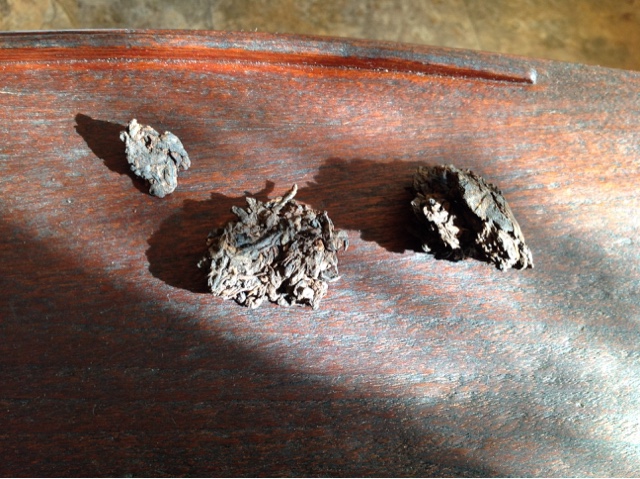
Old tea nuggets, lao cha tou.
So, I have had this baggie since June and now we are in October. I let the tea stay open in the baggie for a couple of weeks but since June it did not develop much smell at all. My older shous in crocks are more fragrant by contrast. I am guessing this tea is preserved “as is,” but not as actively aged like the newer company productions.


I brewed up some chunks, and the tea is clearly a “lao cha tou,” or the lumps of shou that occur in a pile setting and are normally broken up before pressing into cakes, unless deliberately sold as chunks. This tea took several rinses and a sitting in a very hot Jian Shui clay teapot to open up. The tea is quite lively in the mouth, and to me appears to be a less heavily fermented shou than is usual with lao cha tou, probably evidence that the tea was a project that got left unfinished. It has the wine and mushroom flavors of other lao cha tou teas.


Cloudy brew with yellow ring
shows the fermentation halted.
Two issues with this tea, one is I found some char in the strainer and charred, burnt twigs. The other issue is the tea lacks clarity, evidence of a bacterial imbalance that probably occurred as a result of the fermentation left unfinished and uncontrolled. This is not obviously representative of any of the current products by Longrun, rather this is a historical vintage product from the old days. So nobody can generalize Longrun’s current products based on this shou. This tea certainly appears to match the story of “left in a pile.”

I steeped about eight times before the steep time needed increasing past flash steeps. The tea is not yet fully fermented and can benefit from further aging, evidenced by the yellowish ring around the cup and tinge to the tea, for it is still very slightly raw. The clarity will improve, the tea cleared up quite a bit for the ninth steeping, yet fully clearing will take a long time and I doubt this will ever be a great tea. The brew was not funky or fishy at all, but the wo dui is still strong for a twelve year old tea. In fact, I enjoyed much more Longrun’s later 2007 vintage shou, a cleaner tea with a perfect storage flavor.


Just nothing left after nine steepings, even when boiled.
The tea fell off after nine steeps. I tried boiling the leaves hard on the stove which often yields a nice cup from older shou and lao cha tou, but these leaves were done and I could not get more than just mildly flavored water. But hey, factories do not make premium shou every day and this tea was merely one current project when the factory changed hands. It is what it is. A photo of the wet leaves is difficult to capture the tea, even with my naked eye the lighter brown leaves are hard to distinguish after all that brewing.


A couple of charred sticks, some lighter brown leaves.
What is so special is that this 2005 is a vault tea from Longrun, part of their history as a factory. I am incredibly lucky to taste a bit of this history, for I doubt many people have this kind of opportunity and from such a famous factory as Longrun. I can appreciate the rough character of the old shou because it matches the story behind it, the tea tells that story perfectly well. I can appreciate also that the craft quality of shou tea is now at a new level due to science and improvements in industrial production. A comparison of this tea with Longrun’s newer products illustrates the company’s journey and achievements. The resulting financial and commercial success speaks for itself.

I want to thank Longrun for this rare opportunity to drink a bit of their history. This is a special experience I am not likely to have again in my lifetime. I feel more favorably disposed to consider Longrun teas after drinking their finely stored 2007 vintage. I worry that someday the premium teas may no longer be available in the west. A company like Longrun aiming for excellence and selling in the western market reassures me that we will always have something to drink.