; Cwyn's Death By Tea ;

Sunday, April 5, 2015

A "Bit" about Qi

"Impression," 2014 Yunnan Sourcing
I want to write a bit about the concept of qi in tea. People have an understanding and experience with this quality of tea, but describing it in a rational way is difficult, and can get contentious at times. We westerners hit a brick wall when talking about qi because we get slapped up against our cultural dualism, a split between science and religion. We also get stuck because ethnic religious ideals embedded in our culture contradict the concept of qi. I will start with more general issues on why this concept is difficult to promote in the west, and then finish up with my more personal experiences.

Qi is the Pin Yin for breath, Chi is the Wade-Gilles. The compounds in tea that are identified with the qi effect are generally referred to as theanine. Theanine crosses the blood-brain barrier and increases the production of alpha wave states in the brain that we experience in REM sleep and during meditation. The practice of meditation is the exercise of observing one's breath. The goal is to lengthen the attention span in order to discover more subtle internal sensations. Circulation of the breath is the movement of qi. Qi is viewed as a life energy that permeates all living things.

The Problem of Pantheism

The concept of qi is the life energy of the universe, not merely theanine. What does it mean to say that a cake of tea contains qi? If we view qi as Oneness, or One energy, then this very general idea doesn't clash so much with western religious notions of spiritual energy from an all-powerful, Omniscient and Omnipotent God. However, qi found in an object is problematic in western theology. A tea cake is an object, not a person. Pantheism is the idea that Everything is God, and the essence of the divine can be found in all elements of nature. So God can exist in a tea cake, a wafer, a tree, or animals. For the "qi/God is in everything" concept to hold logically true, a Tea Cake must be the same as a tree, an animal, a table, a bridge, a rock, a child, a rosary, a crucifix, and a communion wafer. Either all is One or all is Not One, for every Set A we have Not A. As soon as we split qi into objects that "have it" over objects that don't, we no longer have a singular concept of qi. Instead we have a dualistic concept of positive and negative.

What do we call things that don't have qi? By definition, everything must have the same universal energy, or the concept is flawed. Tea cannot possibly have qi in a way that any other object lacks. Unless of course we are referring only to the chemical compounds. What about relative qi? Does qi exist in degrees, with more qi in humans and somehow a lesser amount in animals and plants? If not, then what makes a tea cake more than any other object? I could eat an orange or a yak and the same effect exists and I'm merely ascribing more to a tea cake out of fantasy thinking or only because the chemical compounds are fooling my brain.

This logic problem is where science gets hung up on the idea of qi, making systematic study impossible. For qi to make sense, it must be everywhere and in everything, or we run into problems of definition. Trying to prove Qi exists is a similar problem that Thomas Aquinas grappled with trying to prove God exists, we find a tautology, a circular argument that falls back upon itself.

I think the best scientific idea we have right now is the theory that all matter contains particles from the original Big Bang, when matter "won out" over anti-matter by an unexplained fraction of a chance, the moment when perhaps an intelligence beyond us made the call. So maybe the energy of qi could be the remnants of the original creation of matter in the universe and all matter is equally filled with this creation energy. Einstein and Hawking tried to come up with universal ideas of everything. But the truth is, universal theories are problematic once we begin to differentiate one object or being from another and then attempt study specifics. Einstein's flirtation with Pantheism came via reading Spinoza. In the 19th century, Catholic Christian theology rejected Spinoza, and declared the notion of Pan-theism as heresy. As a counter-argument or attempt at clarification, theologians came up with an idea known as Panen-theism. Panentheism is by far more prevalent in western culture.

Panentheism and Eschatology

Panentheism is the idea of God as Omnipresent in all dimensions but also removed, existing in another reality outside of the objective world we know. Instead of spiritual energy existing in everything equally, the Human Being is viewed as the center of the universe. Objects or non-human beings like animals are thus viewed as lacking soul, or essence. If God is said to dwell in an object or person, it is only in another dimension, not actually within the real properties of the object. In this view, life force energy cannot be said to exist in any object. Under this notion, a puerh tea cake certainly does not qualify as an appropriate vessel for divine energy. 

Where Pan-theism means Set A is divine everything, under Panen-theism the Divine Alone is Set A and everything else is, by default, Not A, until proven otherwise. The heavenly dimension where God/Allah/Jehovah exists is where the righteous dwell, along with 40 virgins and a resurrected Jesus. Where we live is outside of that dimension, though the divine can somehow insert or intervene, a moved or unmoved mover. But God would never deign to lower to a teacake, though God is viewed to have lowered himself into bread in the myth of Jesus, a singular exception that Christians believe. A saint is made and not born, holiness must be rigorously tested. Such a rationalist western idea, and a far cry from the unifying life energy in the concept of Qi.

Early believers in the resurrection of Jesus believed Christ would return imminently, which gave a defining eschatology to the Christian religion, though all religions have theories of the End Time. Christianity and Islam both have a most urgent eschatology, earthly life doesn't compare with the world to come after death. Heaven is not earth, and the point of religious practice is to leave this world and get to the next one with a front row seat. If a divine Qi exists, it is in an alternate dimension and the whole goal of life is to hurry up and get to this new dimension.

Urgent eschatology is both a method and a lifestyle. When you expect or hope to die tomorrow and wake up with the Divine, you live accordingly and keep yourself on a path worthy of such a fate and avoid anything that could affect your spiritual expectations. Very likely this conformity means adhering entirely to the tenets of your own tradition and avoiding exposure to anything outside of it, or contrary to it. I've observed this struggle in a tea friend who wants to get into puerh tea, but is dealing with a religious tradition which disapproves of caffeine addiction.

An urgent eschatology is a method of spiritual progression worldwide. Most religions have some notion that a Fast Path to divine union is possible. Tea can fit into an idea of the Fast Path, along with mushrooms, weed, LSD, meditation postures, Tai Chi, frequent Communion, evangelical practices such as talking in tongues, ecstatic dancing and singing, faith healing, revival meetings etc. At the very same time, eastern and western traditions of meditation also advocate Rejecting all Manifestations, specifically ignoring experiences of minor ecstasy in favor of pushing toward the ultimate union with the divine. Like St. Therese of Lisieux advocated, throwing oneself into the arms of God like a little child, rejecting everything else and everything less than God alone. This notion of rejecting all but God has taken hold in western culture more than we realize, back to a time when Jesus was expected to return imminently. If the world ends tomorrow, one finds it difficult to believe in, or care about concepts like a life force permeating a tea cake. Overcoming a preference for the Big over the Little means a culture must reject the idea that our Personal God/Messiah is coming to get us anytime soon.

Rejecting all but God can also include rejecting society and ideas outside of our cultural tradition, making the adoption of concepts like qi even more unlikely, unless qi is already a part of the tradition you're in. Immigrants to the Americas brought with them language and cultural religious traditions to their new country. But after immigrating, most ethnic groups keep to themselves, viewing the outer culture of the Americas with a moral suspicion. Major western religious groups all share a tendency to view holiness as endemic to their own cultural group. In other words, the path to holiness and the divine is due to participating fully in a cultural religious tradition that excludes those outside of it. So here we have powerful family traditions that erect a massive cultural barrier between those on the inside and those outside. Even if some unifying concept like spiritual energy exists, cultural groups reserve this energy for themselves and specifically condemn anyone outside their group as inherently unable to obtain the same experience. Such exclusivity adds to the logical and theological problems already present in the idea of a unifying life force energy potentially located in a beverage.

Anyone born into such a cultural tradition is likely stuck for some time. Maintaining the integrity of the group is a powerful force for at least two more generations after immigration. Once people assimilate and begin adopting a more secular lifestyle, they feel more free to start borrowing ideas and become more individualistic, more prone to personal philosophy that may depart from their original ethnic enclave. So today we have people who might belong to a western religion but they also attend yoga classes, and nobody sees any contradiction in that. For many people, exploring eastern philosophies is additive, or part of a pick-and-choose consumerist mentality with spirituality.

Summing Up...

So let's sum up the problems with a concept of Qi in western culture, and why such an idea is difficult:

1. Proving qi exists seems impossible, as a tautology.

2. Whether Qi exists in relative degrees.

3. Unresolved logic problems, what has qi and what doesn't.

4. Culturally rooted Christian theology has rejected the idea that a divine energy can exist in any object except a communion wafer.

5. Western philosophy promotes the idea of spiritual energy existing in an alternate dimension.

6. Major Western religions have an urgent Eschatology, a focus on life after death and arriving at another dimension.

7. Most religions have a Fast Path method, rejecting "lesser" spiritual manifestations in favor of the alternate dimension, full union with the divine, or the after death experience.

8. A moral view that drugs or artificially-induced states are not the same as spiritual states, even when an analysis of the brain action shows they are the same.

9. Immigrant religious groups promote the idea of salvation from within the group, making the adoption of new ideas difficult for at least two generations.

Faith and Belief

I think we can reasonably conclude that the concept of Qi, aside from the chemical compounds present in tea, is not a concept that currently can be studied with scientific method. So, right now Qi is an idea of Faith and Belief, relative to the Individual. Here we are again in the Relativist Universe of Tea. You can tell me "No, Qi is objective" but I think you'll end up in a tautology when you try to explain it. Instead, we'll have an easier time of it moving to the other side of our brains, that of internal experience. St. John of the Cross, the great Carmelite monk who wrote of the dark night of the soul and union with the divine, instructs that the pre-requisite is to quiet the senses and empty the rational mind. All that is Objective is put to sleep. We need to do this if we want to explore whether Qi really exists in tea as an experience greater than the sum total of its theanine content. 

During my training as nun I was sent to study at a meditation center with a Sufi master who also had training in unitive methods across religious traditions. I was exposed to the concept of Qi when taught the first 40 postures of Tai Chi, psycho-calisthenics, Buddhist walking and sitting, breath techniques, and even the idea of circulating deep breaths when giving a social hug. Circulate the qi with your neighbor. The point of all of this, along with the training I'd had as a novice in Catholic inner prayer, was to prepare myself for a life as a contemplative nun in which the goal is nothing less than union with the Divine. My training emphasized the idea of the human being as the ultimate container of Qi. When I first encountered the idea of qi in a tea cake, and the idea of looking for this experience in tea, I felt rather uncomfortable thinking of qi in an object like tea.

I learned that a continual practice of observing the breath eventually will pay off if you have Manifestations, regardless of the type or source. Manifestations are experiences which we cannot explain any other way except as spiritual or religious. Feeling Qi in tea is one of these experiences. Most spiritual masters instruct us to deepen our attention and continue our breathing and prayer practice when a Manifestation occurs. I was taught to observe and deepen the experience when it happens, rather than chase it away. I might have to let go of cultural exhortations that tell say "you must not feel that" when the Manifestation occurs. At the same time, both Christian and Buddhist teachers say we should not develop an Attachment to the manifestation. We are to look further, to look for God above all. Or the Nothing of the Void if that is what you believe.

I have had a type of Manifestation since the age of 33. It is the experience of everything around me as a golden wash of light. I see and feel this. It came after a change that happened to me psychologically due to my practice. This was a difficult change and I sought a swami to help me through it. Christianity does not have all the spiritual guidance tools I needed due to the Fast Track and Urgent Eschatology. Which led to the Cistercian monk Thomas Merton traveling to a Buddhist monastery in Thailand when he needed more help. He knew where Catholic contemplative method ends, and how much more developed methods are in Buddhism and Sufism, just to name a few. Because of Thomas Merton, I know when I need help from traditions outside my own training. I hit that underdeveloped wall in Christianity which is where Manifestations like Qi reside.

The manifestation I have is something I participate in, rather than fully control. I might be able to do more with it if I had more help today, but this is not very important to me. The experience of the light comes and goes. I can relax into it, and do my breath practice as I've been taught. Sometimes I get it when drinking tea, but I haven't noticed that physical sensations from tea automatically produce the manifestation, even when tea drunk. I can relax and breathe and very often experience the manifestation whether I'm drinking tea or not. But I have been taught very clearly that experiences like this are NOT to be sought, because a person can get stuck in them like a side road on a highway. They are not an end in themselves, despite all my jokes about Tea Drunks. My jokes are part of my Foolishness, as Francis of Assisi taught about embracing the Fool in ourselves. I believe that it is entirely possible to participate in something that my rational mind finds absurd.

Where to Go from Here

I'd like to recommend a book Spiritual Cannibalism by Swami Rudrananda. Rudrananda born Albert Rudolph (1924-1973) in Brooklyn, New York, was raised in Judaism and became a practitioner of Ratha Yoga. I think some of the principles of Ratha apply very well to consuming tea. Swami Rudi's method and practice was entirely about the physical body. The human being is the greatest container of Qi. Rudi's work is very short, just a couple hundred pages, but these were very helpful to me in physically assimilating emotional experiences through his image of the body as a Blast Furnace.

Garbage in Yunnan. If all is one, there is no contradiction.
"An open fire fed by enormous logs burns large amounts of fuel. A pot-bellied stove uses less wood but gives more heat. So, too, a calm exterior not only conserves the inner fuel but, being less visual and external, does not capture the mind. It also heats deeply and for longer periods of time. A person seeking truth should not be caught by outer drama or illusions. Within a spiritual being, deep surrender should collect fuel from everyone and everything. It is our conscious need that continually brings us this material for our internal furnace. Everything, to be of service to make us grow, should be consumable--surrendered and used as fuel."

And...

"A steady diet of refined food or vibrations will not suffice to attain the ideal growth that is theoretically possible. It is not possible for a human being to change the inner condition by just fasting or altering the diet. To effect a real change, conscious effort is needed to clear out the system and allow it to grow organically strong enough so that it can absorb the change. Real change takes several years of effort."

Swami Rudrananda, 1973. Spiritual Cannibalism. Links Books.

Qi experience from tea is like pouring water on the hot pot-bellied stove so the steam rises up. Just because we drink tea with qi compounds, we don't become qi because we already ARE qi. Our bodies and the tea are all one in qi. The qi reminds our bodies and instructs our minds in what we really are, especially the mind because it is a slow donkey which understands nothing, Brother Ass as Francis of Assisi used to say. If we think tea is the only thing with qi and we ourselves are not qi, then we are experiencing an essential lack, a need. A craving for sugar, or chocolate, has been compared to a need for love. If I think tea merely contains qi, then I am forgetting who and what I am.

Still the Split

If my writing here is indicative of anything, it illustrates the split between rational thought and experience within a particular cultural background. The only possible middle ground is to continue to observe and to feel. Drinking tea provides an opportunity for continued contemplation, regardless of our traditions and beliefs. We are closer now than 20 years ago to absorbing ideas like qi which are not native to the west and we have more tools with which to study experiences contrary to current scientific reasoning. Our cultural experiences are a door we pass through to new understanding and the fuel for the fire that heats our Tea.

Easter 2015


Wednesday, April 1, 2015

A Nun's Penitential Biscuit

Penitential Biscuits

Penitential Biscuit of the Franciscan Sisters of Perpetual Adoration
聖方濟各永久朝拜聖體修女會

Ingredients

1 cup shortening (or 1/2 cup margarine and 1/2 cup butter)

4 Tablespoons sugar

2 eggs

3/4 cups blackstrap molasses

3 cups natural bran

3 cups flour

2 tsp salt

3 tsp baking soda

1 tsp baking powder

1 cup buttermilk


Procedure

   1. Cream shortening and sugar.
   2. Add eggs and molasses.
   3. Mix bran, flour, salt, baking soda and baking powder together.
   4. Add dry mixture to egg mixture alternately with buttermilk.
   5. Use ice cream scoop to drop biscuits onto a lightly greased cookie      sheet.
   6. Bake at 350 degrees for 15 minutes.

Makes 18-24 biscuits depending upon size.

Recipe provided through the kindness of Sr. Marcella Marie Dreikosen, FSPA.


I use crushed bran cereal.

Then cream together the butter and sugar.
I don't own a mixer.
Add the eggs and molasses.


Mix together the dry ingredients. I just add them to the bag I used to crush the cereal, and shake the bag up good before adding it all a bit at a time.
Stir everything up well.
Add the dry ingredients a little at a time along with the buttermilk, stirring everything up well between additions.

Drop rounded scoops of batter onto your greased cookie sheet. Bake for 15 minutes.

Finished biscuit is about the size of a hand.
These salty sweet biscuits were served on meatless Fridays along with salad for the noon meal. Sister Marcella ran the kitchen in those days. She is retired now, and graciously hunted down this old recipe which suggests it is no longer being made. The name Penitential Biscuit is a bit of a misnomer because they are so delicious, and Sister Marcella didn't like anyone calling them Penitential Biscuits.

"It's a bran biscuit," she said, a little offended at the idea that the biscuits might be a penance to eat, or aren't very good.

But in fact they are so wonderfully savory and sweet, we would say "Penitential" as a loving bit of humor, that we are supposed to be doing a penance but the sisters in the kitchen loved us all so much that instead we are eating beautifully. Before today, I have not had these biscuits for 28 years. I put raisins in my recipe, though we never had raisins in these biscuits.

Then I chose a roasted Fujian oolong by white2tea to go with my biscuit, and I suggest a roasted oolong if you plan to drink tea too. 

Choose a roasted oolong or black tea.

Didn't expect the tears at first bite, but clearly my taste buds have found a very old memory.


Requiescat in Pace.


Friday, March 27, 2015

Untanned Yak Butt 1994 Ya'an Kang Zhuan

1994 Brick Heicha
Brick heicha is tea for the brave, or the crazy, of which I'm definitely one, and crazier than usual. What was I thinking when I ordered nearly a half kilo brick of 1994 Sichuan Ya'an Kang Zhuan from Chawangshop?? Someplace on my bucket list I can now cross off the "to-do" experience of tea stored in untanned yak hide. Apparently I thought I needed to try this. Maybe I'm just naughty and contrary, reacting somehow to all the lovely tea websites and blogs which feature serene, meditation quality photos of tea leaves and heavenly gong fu, where even the tea cups seem to be levitating on a sea of spiritual ether. Something in me wants a slap of reality. Perhaps it is the former nun in me who knows the tendency of people to romanticize monastic life, when I know darn good and well that the monks in Lhasa, Tibet aren't drinking tea from levitating cups. They aren't even drinking the lovely things I get from places like white2tea or Yunnan Sourcing. In fact, they are drinking tea hauled up the mountain in untanned yak hide.

Here we have a brick tea meant for Tibetan consumption and thank god places like Chawangshop exist to allow people in the west to purchase the real nasty stuff. This brick is sold for $55, and interestingly enough Chawangshop also has a 1993 brick of what appears to be the same tea, but sold for twice the price at $108, apparently because it tastes better than the 1994 brick I bought. I have a feeling I know why, because my 1994 brick heicha has the real yak butt flavor. Just so you know what you're getting if you end up perusing the Heicha side of the Chawangshop catalog. This tea was made by the Yingjing Tea Factory in Ya'an City, Sichuan Province, and represents the Sichuan heicha tradition. The 1994 brick that I have also has the book article in the listing about how this tea is packaged up in such a way that three gams per side on that yak yields a balanced load. The fun bit is how the craftsmen sew up these bricks into untanned, soaked yak hides which then harden up around the tea to protect it from all sorts of weather on the way up to Tibet.

Looks like what I raked up last fall in the yard, but these leaves have Tibetan neipaio
This tea is meant to be boiled down to a rather thick syrup which can be left to cool, and then reheated as needed with yak butter and salt, and finally churned together into a froth. I debated with myself whether I should boil the tea, and then decided instead that boiling rinses might suffice and I'll just gong fu for the first time. The brick looks looser than it is, in fact the tea is quite compressed and my plans to break up the entire thing for storage changed quickly to just chipping off some to jar up for drinking in the short term. I had trouble even getting a sharp knife into this brick after taking off some of the loose tea around the exterior. I tossed the yellow paper and instead wrapped the remaining brick up in an old beeng wrapper.

The leaves are on the thin and papery side, the edges of the brick remind me of Wisconsin tree leaves that have sat on the sidewalk against the house all winter long. When you try and brush them away, they are stuck together in a flat pancake. I didn't weigh out my tea because my scale tends to be a bit inaccurate when I am trying to weigh lighter leaf teas such as this one, and such as Tai Ping Hou Kou, the scale just isn't sensitive enough to detect when I've added more. And the flat "chunks" I chipped off were too wide for my presentation dish and I need that dish when I weigh tea.

Brewed the tea in Yixing. I did four rinses, because I can definitely smell the funk here, what must be something like untanned leather, hence the yak butt. After the fourth rinse, most of the smell seemed to be gone. Poured myself a cup, which to my surprise tasted like...well...heicha. That black-tea-plus-shou flavor I've had in other heicha. This one had a spicy start and then, RAISINS. Yum, gave my leg a slap in glee. Tastes like mincemeat with a side of lard, or that cup of coffee after gutting a deer. I didn't just say that. I know the Buddhist vegans are falling over in a faint by now, certainly the ones in Madison who threw tomatoes at me when I wore vintage mink coats. Yet I wonder just how much fun the cuisine on that fantasy Lhasa retreat now appeals to those still dreaming of that type of vacation. Yessiree, how 'bout that boiled barley dough rolled up in a cuppa this untanned yak butt brick?? Heheheh.

A lovely cup from one unattractive brick. Yum.
I happened to have a can of evaporated whole milk open in the fridge which I use for coffee and decided to try that in my second cup of this heicha. However, by gong fu brewing this tea I didn't have a strong enough brew to handle the flavor of the whole milk, and it overwhelmed the delicate flavors of raisins and mincemeat I was getting out of the cup. I would need to really boil up a large amount of this tea down to a super concentrate before adding any milk fat products if I expect to taste anything of the tea.

Overall the tea is incredibly warming and yang. Three cups of this and I was sweating and had to remove my sweatshirt down to a t-shirt. But I am a cold weather person already, this tea is a good choice for cold weather like the Himalayas and Wisconsin. People here start wearing shorts and t-shirts outside when the temp crosses over 0 degrees C. Anyway, I only needed about 3 cups of this heicha to get overly warm. It still tasted of that "side of leather" after 5 cups, and started to thin out after 7 cups and believe me I didn't need any more at that point. I've noticed with other heicha that the first four cups or so are the best. Then again, I did four rinses and all those rinses wash away some of the tea at the start.

Use a vessel much bigger than the dry tea so it can expand.
Now I have the problem of storing the brick for further drinking. Luckily I have a couple of vintage Belgian jars, in the short term I can keep some loose tea without needing a skill saw. Maybe I can get Chawangshop to send me some untanned yak leather with my next order.

Vintage Belgian jars.
For $55 I think I got a deal in the 1994, the one year older $108 1993 brick would have to be damned stunning for me to pay twice over, but this rural gal is not gonna pay that much for heicha. I'd rather have a better beeng for $108. However, I do like my heicha because it is soothing for Old Ladies on Medication like myself, and $55 for about a half kilo with a little yak flavor suits me fine. Will definitely be drinking this up.

Requiescat in Pace.

Saturday, March 21, 2015

When Crock Puerh Storage works TOO well

Jar on the left is the culprit.
Today I discovered one of my storage jars seemed to be developing a touch of mold on top of the tea and I decided to pour out the loose tea into a larger vessel. To my shock as I poured out the tea, it had not only gone to shou but gone past that into compost!

Ack.

This tea is a 2004 Jian Shen 100g tuo from white2tea, a very inexpensive tuo at $9.90 fortunately. These tuos, when purchased new, exhibit dry storage and are fairly green. Originally I bought a pack of 5, so 500g (half a kilo!) of tea total for around $50.

Two months ago I decided to break up one of the green tuos and put the loose tea into the jar shown above. We are still in winter and at the time my household RH was around 24%. I added no additional moisture to the tea. Now, two months later I have compost.

Rather shocking considering how DRY the house is. But the good news is that the original crock where I'm storing these tuos is working far better than I thought!

Frankoma Crock where the rest of the tuos are.
I haven't added any additional moisture to the crock of tuos all winter. No clay shards, no pouch buttons. The lid on the crock is a bit loose, it moves around. Back in January, I thought perhaps the tuos must be getting dry, even though I can smell the tea. Now I've learned the Frankoma crock is working just fine. Last fall when I started posting on crock storage, I felt that a 2013 Bada Shan sample stored in Frankoma had the best progress of any of the crock types. Frankoma is a red ware clay.

Obviously too I had overstuffed the small storage jar with the Jian Shen tea. But with no additional moisture added, and an RH around 24% in the house, the ONLY way the Jian Shen tea obtained enough moisture in it to rot like this is because of the PREVIOUS moisture the tuo back from 6 months or more in the Frankoma crock. Here is another Jian Shen tuo from the Frankoma, as of today.

A current Jian Shen tuo, unwrapped for the photo from the Frankoma crock.
You can see it is browning nicely, but is dry enough and not moldy anywhere. So I got some good data from this accident.

1. Don't overstuff the crocks.

2. I can leave the wrappers on.

3. I may not need to add additional moisture to wrapped and crocked tea even when the house is exceptionally dry.

4. Frankoma red clay pottery is still my #1.


Thursday, March 19, 2015

Wymm-en Puerh

Wymm Tea sampler sachets
I tried to refuse this week's tea sampling. When Wymm Tea contacted me about trying some of their puerh, I took a look and saw green, green, green. This isn't puerh for Old People. It's puerh for young wymmen. I'm old wimmin, that "y" chromosome is no longer anywhere near my general direction. I even said "the teas we are looking for are already aged like we are, since we do not have the years left for long term storage. Thus I don't review many newer sheng teas unless my son wants them." Wymm Tea responded to all that with "we will take that as a challenge." Sigh. Okay, then I yam what I yam and that's where the y comes in.

The y also comes in again with the packaging for the tea is wrapped in fancy soft paper, thread and leather tag. Unfortunately, the paper is scented with something. Whyyyy??? I can't tell if these samples are bath sachets or something I'm supposed to drink. Even worse, the delightful vendor enclosed a typed letter to me in a 4 POINT font. I can't read anything smaller than 12 point and preferably 14 or even 16 point. My old age would be even more depressing but for the miracle of e-books. I refuse to read what gets printed as Large Print in the US, mostly romances and biographies of Jackie Kennedy. At least with an IPad or e-reader I can set the text size to what I want, allowing me to read almost any book. Anyway, can you read this?? My 24 year old son couldn't read it either, sadly, so I let the cat eat it.

This is what a 4 point font looks like to this old lady.
The packaging and marketing of Wymm Puerh tea is geared toward a type of female consumer who is super hot right now. The Obsessive. She can be seen in film and on TV. She is Gillian Anderson in "The Fall." Robin Wright in "House of Cards," Maggie Gyllenhaal in "An Honourable Woman," or Claire Danes in "Homeland." In real life perhaps the Duchess of Cambridge. A recent piece in the Telegraph attempted to describe this type of woman as wearing "clean lines" clothing, high end labels, more specifically "businesswomen whose dress sense was as sharp as their brain power." The article tries to focus on the career role these characters play as the reason why the clothing is fascinating. But the author got it wrong. It's not just the clothes we are fascinated with, nor the career, we are looking at a woman who has a specific type of Control. For she:

1. Doesn't eat.
2. Smells fresh.
3. Is thin.
4. Has perfect teeth.
5. Doesn't eat.
6. Never spills.
7. Can wear heels all day.
8. Is immune to clutter.
9. Has perfect skin.
10. Doesn't eat.

She has, in other words, the perfection that all eating disorders seek to achieve. It's not even solely about being thin, it is about the Control. Her anorexia is so perfect she doesn't menstruate so no mess on those clothes.

And then she has a particular type of house. The immunity to clutter is of course paramount. The house is the sort we see on every makeover on HGTV. Open concept. White kitchens and bathrooms. Marble countertops. Stainless steel appliances. Apron sink. Glass showers. Dark wood floors, no matter that dark floors show dirt and are difficult to keep clean but she DOES keep them clean, and that is the achievement of these floors. The kitchen is never a mess because she never cooks. The fridge is empty except for bottles of water, or maybe a half drunk bottle of fine wine a'la Carrie Matheson.

In this type of environment a customer like Claire Underwood welcomes scented rice paper wrapped tea samples tied with string. No loose tea to *oops* drop down into the bra or heaven forbid into the bed. Probably best to brew outside, unless the sachet is dropped directly into the bathtub. The tea is completely controlled. At least until we find the stray pubic hair in the cake.

I'm exaggerating and I didn't find any pubic hair this time. But what many women and marketers don't realize is that what we admire is television, and television is scripted and set-designed and then edited. Television is theatre, not real life and not even a mirror of real life. Reality is the cats are on the countertop when I'm not looking and I'm sweeping up cat hair. And I'm a normal woman so I'm messy. I spill. I drip. I splat. My hair gets greasy and guess what my tits aren't the same size so those expensive bras won't fit anyway.

How many women are going to admit they prefer bug bit wrappers? "Guess what, Lindsey, I just got a new tea cake. Yep it is full of bug bites!" You can imagine the horror. Not to mention "omg the mold, it's awesome." But I digress because the real point to remember here is not about the packaging or the image. It's about the Control.

Puerh tea is never going to be the product for women who admire Control. Initially they might be attracted to the idea of the "slimming" prospects of puerh tea, however most of these women are already thin. And truthfully, the Puerh Hobby is too Messy. You will have spills. The tea erodes the finish on your furniture and floors. Loose tea flies around and gets into everything. You can package your Pu any way you want, and she might buy it once, but the Controlled Woman cannot ultimately handle the realities of storage. Her cakes will be dry because there is no storage solution clean enough and she doesn't like humidity and fears mold. For these women, even the best puerh smells wrong. It's the smell she is trying to get rid of by douching.

Sachets are single-session. Laohuangpian.

The smell I really need to get rid of is the scented paper. I chose the Laohuangpian, which is sold in a bamboo-wrapped brick for $58 Canadian. Unfortunately the website has no information on where this tea comes from, so we don't have any origin on this tea. The samples are enough for a single session.

Soup is the usual light lemon and the flavor is white grape rather than apricot which is a good sign. First three steeps have the bitterness we are looking for in an ager. After six steeps I'm adding time, and past eight steeps I'm squeezing out a cup. But hey, it's huangpian, the old leaf at the bottom of the tree. 

Second steep.

The real story behind Wymm Tea is the price of some of their other teas. While the huangpian is one of the least expensive options, they also have a 2013 Autumn Bingdao 200g for $998 Canadian! I think about Yunnan Sourcing's 2013 Autumn Bingdao which is $58 for 400g by comparison, also claiming to hail from 100-200 year old trees. Wonder if Wymm Tea did their comparison marketing research. Even if their version is far and away the better tea, I'm having a hard time imagining how tea buyers are going to see the value in paying nearly a grand for half the tea that Yunnan Sourcing is selling. I mean, you can't taste online after all. Unless the tea is well, meant for the tub.

Some bigger leaves and even buds in this.
Or maybe the Wymm customer isn't looking at Yunnan Sourcing late at night instead of sleeping, as many tea drunks might do because they won't get caught by their partners who trip over tongs on the way to the loo. I get it that Wymmen don't want bug bit wrappers, but what nags at me is puerh buyers are largely men. Look at badgerandblade "sheng of the day" forum. These guys are straight razor, Scotch whiskey drinking Brit chaps and they are not gonna want scented puerh wrappers anywhere except on their girlfriends. Aside from that, I'm grateful for the samples and wish Wymm all the best in their endeavors.

Requiescat in Pace.

Monday, March 16, 2015

Wilson and William


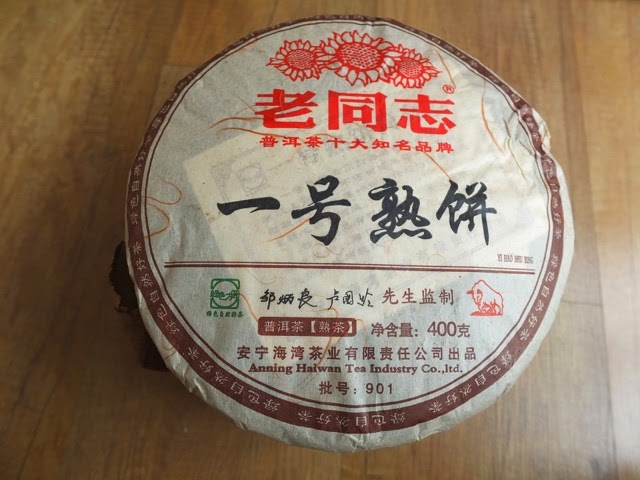
Wilson's 2009 Haiwan No. 1 Shou
Recently some tea samples arrived in the mail from tea blogger Wilson, making me a grateful recipient of tea that I surely have no chance of trying otherwise. Wilson's tea blog travellingteapot (see my list on the right--->) is one of my favorites, what I might call a Tea-se Blog. Wilson lives in Singapore, and traveling to China for tea buying is a day's trip by train for him. Consequently I can live vicariously through his tea buying tours and see the lovely tea ware and BOXES of tongs he hauls home. His blog is a bit of a tease though because the entries are all too short and spare. Very often we get photos of amazing cakes and I get all worked up, only to discover that nope, he is not going to unwrap that cake and show me the goodies. His beauties hold their bling in tight chastity belts of bamboo and holographic stick-on's. Initially I thought to myself, perhaps he didn't have time to finish the post. Then I began to think he does it on purpose, yes that's right, except with no opportunity to hold up another dollar bill to keep the dance flowing. My Distress increased further when Wilson posted photos of 1998 Xiaguan tuos in the BAG that never opened.

Luckily I got a small sample of that Xiaguan which I'm saving for another day. Today I'm going to try a 2009 Haiwan Lao Tong Zhi 901 Ripe, which we actually got to see earlier this year. You can read about this tea and also a story about how Wilson bought 8 tongs at Haiwan Tea Shop in China. The chunk I got reminds me of chocolate, chunka-chunka buffalo on my vintage cafeteria ware.


Nine grams of this and I notice the wonderful quality of the leaf, this is one pretty cake. Opens quite easily with hot water. I notice the buttered toast scent which isn't as powerful as the Lao Cha Tou I've been drinking lately, but the tea is very smooth. I'm impressed at the dry storage Wilson manages in Singapore. Eight tongs, eh? Maybe he has tongs instead of furniture, then again eight tongs hold a tabletop, don't they? Tea soup here swirls crimson and coffee colors.


Wilson isn't the only traveling tea pot these days, we also have William. Prince William, Duke of Cambridge that is. ABC News in the US reports on The Royal Duke's trip to China this week, which supposedly focuses on football and other cultural missions. Then we read of the plan for Wednesday this week.
Anyone else spy the covered cups/gaiwans on the table? Photo and story ABC

"On Wednesday, his China trip winds up in Xishuangbanna in Yunnan province near the Myanmar border, where he will visit an elephant sanctuary and a nature reserve." 

Okay, let us deconstruct this...Banna...in late March...a nature reserve. Any tea drunk fully in their cups sees right through this one. Elephants? Uh huh. Sure. We know the real story here and it looks like gushu. I can see the Daily Mail headline now: "The Prince Drinks Pu." I should send him a t-shirt.

Anyone up for a wager? Whose spring trip will finish up with the better tea, Wilson or William? 

My money is on Wilson. 


Requiescat in Pace.

Update to Original Post later in the day on 17 March

Received email from Wilson who writes he is in Guangzhou right now. 

"Wish u were here... No need to drink water ... The tea intake more than daily water requirements. Just had a tea session from 10am - 6 pm. One of the teas was the famous 88 Qing bing. Same 88 cake as the famous Hong Kong but thus cake was kept by a Guangzhou tea collector."


My little tea wager is a No Contest from the start! Unless the Duke of Cambridge can come up with a 1950s Red Mark. But I think Wilson already has one. I rest my case.

Cwyn

Friday, March 13, 2015

mr. mopar's Puerh Storage


My friend mr. mopar aka mrmopu might be familiar to many of you who hang out on tea forums like Teachat and Steepster. He offers encouragement to new puerh drinkers, promotes discussion on puerh, and hooks up people with similar tastes in tea. He has a remarkable black cat known as "Chairman Meow" who has an odd interest in puerh tea cakes, and "picks" teas by putting her paw on a different cake every day. Very often mr. mopar will choose to drink the cake picked out by the "Chairman." I find it reassuring that I'm not the only odd puerh person of a Certain Age, and that the world holds so many of us. Anyway, mr. mopar sent me some tea recently when I developed a fixation on trying the 2011 Dayi "100 Year" Tribute Ripe cake, but didn't want to pay the $70 for a full beeng which is the current price at Berylleb. He generously sent me a massive sample of that cake and then some other teas to try. When I opened up a sample of a 2005 CNNP Nannuo, I couldn't believe how fresh and fragrant this tea is. The other teas he sent are also equally fragrant and very well preserved. Right away I wanted to share with others what he is doing for storage, because he is clearly doing something right.

To set the context, mr. mopar lives in Virginia, USA, which is generally a humid state in the summer time, but can be drier in the winter with house heating. I asked for a copy of the photo above so you can see the hygrometer settings which show Fahrenheit temp and humidity percentage. The fans he is using for air circulation might be important in the summer for him compared to the northern state where I live. I asked more questions about his storage.

1. Tell me about your set up!
Oh, I got a fridge, and mini fridge, and a wine cooler full with 4 puerh bags with 7 cakes each, and a stack of boxes and bins of samples. I catch grief about it everyday! 
I am using an old refrigerator with cigar humidifiers, electric ones and keeping moisture levels between 70 and 72%. That picture of the pumidor is one of three I have set up. That one is mainly white2tea and Hai Lang Hao and Yunnan Sourcing. I have another for Dayi, Xiaguan, Haiwan and CNNP.
2. How long have you been storing tea with humidity control?
I have been using them for about 2 years now.
3. What other solutions did you try?
I tried the [absorbent] beads but found out they give off ammonia as an after-effect. I do have separate areas for sheng and shou. Never mixed. Shou in the big area of the fridge and sheng in the freezer part. I do also have a mini fridge with just sheng and the humidifier with the computer fans. The fans move 1000cfm so 30 minutes run time gives me lots of circulation in the storage areas.
4. Do you do anything special in the summer?
Summer I just keep a watch and run the fans in the storage area twice a week instead of once a week in the winter, at least 30 minutes at a time.
5. How often do you rotate cakes?
I try to rotate at least once a month. The puerh storage bags make it easy. Pull out a bag, mix them up, and put it all back in. It does seem the fuller they [the fridges] are, the better the aroma, may be the microbes interacting with each other.
6. Are you collecting for the long haul, or mainly storing drinkers?
Oh I just have a small collection...I have some for now and some for the long haul. The newer shengs are aging away from 2008 forward. I do have some older stuff I keep in the same conditions as the stuff I'm aging. My guess is in my older years I will be a tea seller.