; Cwyn's Death By Tea ;

Wednesday, March 30, 2022

2018 Sun Fu Zhuan by white2tea


Back in January I received a box of teas from white2tea containing a lot more than I expected. Twodog had asked me back in November if I wanted some more Fu Brick, and who is going to say no to that? The box contained a full kilo of 2018 Sun Fu, and also a couple of chunks from unnamed Fu bricks that were rejected by white2tea, so a bit of leftover sample teas. I also got two full baskets of the new Liu'An offerings. I clarified that these baskets are 2019, but there is no real way of distinguishing which are which, unless I am missing something, I don't see any labels on them. I also received a couple sample packs of puerh tea. Others have reviewed the 2018 Sun Fu, and I will add my thoughts as well.

Fu Zhuan and other heicha teas are getting much more attention nowadays by tea enthusiasts as everyone struggles with the prices for puerh tea, green teas and oolong teas. Truly fine tea is more expensive every year, and many teas are very much out of reach for people on a budget. A real question I can ask is, would I rather have a very fine heicha or a very mediocre puerh for my money? For the sake of a budget, I find a kind of common sense in turning to a better quality "drinker" heicha tea that may be less desirable, than a mediocre puerh or oolong, especially for daily drinking. As you all know, I mostly drank Fu Zhuan last year as my daily and this tea is quite agreeable and I didn't get tired of it. 

While white2tea has some of my favorite puerh teas, I missed the chance to try their raw 2014 Liu'An, something I have regretted. This Liu'An had long leaves and no aging thus far, which would have been an ideal opportunity back then to buy and have now to compare with the new Liu'An. As for Fu Zhuan, my favorite Fu brick ever was a sample from white2tea sent as a "mystery" tea-with-purchase and traded to me for other teas. So I know TwoDog can find a decent Fu Zhuan when he puts effort to the cause. Otherwise, I have mainly looked to Chawangshop and Yunnan Sourcing when buying heicha. I consider all of these vendors on par with one another in terms of the quality of heicha offerings, and Yunnan Sourcing definitely has more Fu brick choices on offer at the moment.

But I am not a huge fan of drinking really green Fu Zhuan. I like 7 years or so on Fu brick to lose the green and fully brown over. My 2012 CNNP had 9 years on it when I started drinking it last year, and several of those years were in Hong Kong, so I had a nicely aged brick to start. In a factory setting, sometimes Fu is pressed into bricks which are then warehoused a couple of years to get a fermented, more shou-like start to the tea. Sometimes the tea is aged loose first, and then pressed after a couple of years. I remember seeing a Chinese TV news segment on Fu Zhuan and the factories shown were more of the crumbling damp concrete variety, as opposed to the shiny stainless steel of newer-built factories like Mojun. So Fu Brick can have a bit of "dirt" to it, depending on where it is made. 

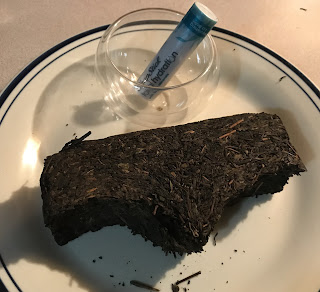
So, I confess to a bit of nose-pinching trying a Fu brick this green. My photo looks a little bluish from the cloudy day, the tea is more yellow-green than blue. The leaves on the brick are larger than those I normally see on Fu Zhuan, mainly because Fu bricks tend to consist of chopped tea. The larger leaves on this tea, if left intact, present a brewing issue: covering the tea fully with water may mean using more water than for an ideally flavored brew. I went with 5g of tea in a porcelain gaiwan, so about 1:15 for me, whereas OolongOwl reviewing Sun Fu used a 1:13 ratio but I am unsure how many grams she used in total, her sample looked a bit more compacted than what I chipped off the end of my brick. 

Steep 1

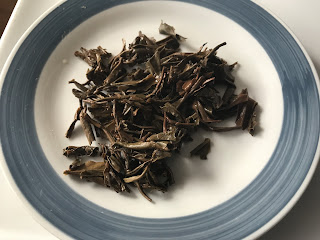
At the outset, I am not seeing any visible golden flowers (jinhua) on the tea. The middle of the brick tends to have more than the ends, but I am not sure this tea has had sufficient time to grow them. Jinhua dry up very quickly too in cold/dry air, but return and grow when heat and humidity are applied. So, it's entirely possible that the tea got too dry on the journey and in two winter months at my house. Right now I am just not seeing any golden flowers here. The dry tea has a grassy scent.

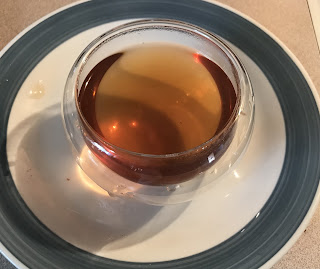
On the first brew, I smell a floral top note along with a bit of mushroom-y shou and lake seaweed, along with a bit of BBQ or ash-y tobacco underneath. The brew is yellow/orange and mostly tastes like hay along with shou. I am not finding the tangy notes of jinhua, however, again due to the youth of the tea. 

Steep 5 was much lighter and a little cloudy.

Sun Fu has a pleasant warming sensation on the body despite the green state, repeating in the throat and stomach. I probably should have used a higher leaf-to-water ratio, because I got about 5 steepings before the tea petered out, compared to Owl's 8 steepings. At the same time, on steep 5 I got less of a hay flavor and finally more of a betel nut note which I felt tasted more like familiar Fu Zhuan. Aside from some body warmth, I didn't feel any qi of note, but I did under-leaf a little for sure. 

The long leaves have a fairly thick and leathery feel. This is what is distinguishing Sun Fu from other Fu bricks for me, these oversized leaves rather than the familiar chopped consistency. I think the chopped Fu bricks give more flavor intensity, because of more tea packed more closely together, whereas Sun Fu is more loose as a brick and easy to pry off because of the leaf size. The large leaves make the brick more unique in my collection and I am curious whether or not this tea ages differently. And of course I want to see if the brick develops jinhua over the summer. 

2018 Sun Fu is priced at $135 for a kilo, 1000g brick. This price is similar to Mojun Fu tea, which is around $65 for 500g. At first glance, $135 seems like a lot to spend on Fu brick, but considering this is a full kilo of tea, the initial investment will last you quite awhile. As I found out in 2021, I need a year to drink a kilo of Fu Zhuan. I am glad to have this in my collection to see how it develops over a year or two, given the intact leaves. I really don't plan to drink this green, and I think it is a waste to do so, although to each their own. 

The only real quibble I have at the moment is with the white2tea inventory. Over the past five years we have seen white2tea really ramp up their offerings. They now have every type of tea, from heicha and puerh to oolong, white tea, red tea and green tea. The motto of the company is a curated tea collection. I feel like white2tea has so many offerings now that the store as a whole doesn't appear as curated and special as it once did. Usually more tea is more value for the consumer, and this is probably true here as well, but white2tea has overstocked past the point of helpful curation. I don't get the feeling of buying their best of the best when I have to sort through 30 puerhs every year, choose between Fu bricks, 4 Liu'Ans, numerous green, white, red and oolong teas. It just doesn't have the special experience of curating down to a very few choices which everyone will be buying in a year. 

However, a long-leafed Fu brick might be worth adding to your collection. I can offer one more good reason to consider a purchase like this. I don't believe we have yet seen the full fallout of the pandemic and unstable global situation on tea prices. Shipping continues to increase in price. I believe we may be seeing the last of "New Year" price increases as a once a year thing, and vendors may be forced to raise prices more than once a year if the supply chain and delivery issues keep up. World events may also close the door on some of the tea buying we have been able to do up to now. While a $135/kilo tea may seem pricy now, this pricing may be history sooner rather than later. Stock up on your favorites while you can. 


Monday, February 28, 2022

Chen Sheng Hao 2012 Zodiac Dragon

Winter is a blur this year. My heating bill for January came in more than twice the amount of last year, putting the brakes on any sort of tea shopping, and mercifully a New Year shipping shutdown halts any temptation. With the extreme cold I have to do laundry daily to keep the pipes from freezing. The cat is sick and I am doing 20 hour days with him. So I missed the message in my Instagram PMs for two weeks from what appeared to be the account of Chen Sheng Hao. Normally I get messages from really sketch tea companies on IG who usually a) follow my account, b) drop likes on 10 really old photos and then c) try and private message me about their tea. 

Hello? I tentatively responded to the message. Yes, the real deal and here Chen Sheng Hao thanked me for my posts last year on their Naka and LBZ sample teas that I bought with my own money. Would I like some more samples? Oh I would. I chose only one, this here 2012 Zodiac Dragon, thinking I would like to try a more aged example from the factory. I suggested they pick the other samples for me, and I got the 2012 plus a selection of 2016 teas. I wish now I also had a sample of the new 2022 Zodiac Tiger which got posted on the cspuerh site two weeks later, after my samples arrived. The 2022 Tiger cost $52 for 357g for all of about two weeks before an annual price increase last week, which bumped the price to $57. 

The New Year Zodiac teas are an annual production and probably the least expensive of all their teas when new. I inquired about the actual harvest date of the 2022 by webchat. Chen Sheng Hao uses the convention of ''Harvest Year" to mean the Pressing year, not the tea year. There is no way this series uses 2022 spring tea because the tea hasn't been harvested yet. I confirmed by web chat with CSH that their Zodiac Teas use leaves from the harvest year prior, and not tea picked in January or something. 

I am very happy and honored to try these sample teas. I can't believe it that CSH actually contacted me and sent me free samples! Not just for me, but for all of us. This is something unimaginable even 5 years ago. We puerh crazies typing away on forums, salivating over stories from tea travelers who manage to see these factories in person and buy tea from them. The questions we had were all about how to acquire tea and the complications of ordering west to east. 

So I have two levels of bias with regard to CSH. One is they sent me complimentary the tea I am trying today. Second, I really really want Chen Sheng Hao to succeed in Canada. There is no question in my mind that other puerh tea factories are keeping their eyes on how business will go for CSH. They will want to know details of this venture. I benefit as a puerh consumer and collector when we get more vendors and now we have the factory direct option like never before, with customer service in English. 

I can't help but feel doubly grateful. You all can pat yourselves on the back too, because your interest and puerh buying activity are without a doubt huge reasons behind CSH making this move to sell direct in the west. If you ever bought puerh tea and chatted in person or online with someone else in your life about puerh tea, then you are part of the momentum to make puerh factory tea more accessible. Of course any business has many reasons to make an international move, but we are at least part of the story.

The story is in early days. No better example of this than I noticed on the cspuerh website that they are using copies of our Instagram posts, without asking first or making it part of the deal. 

I am not sure how I personally feel about this. I kind of don't mind, because again I am so interested in CSH succeeding. In the past I wrote reviews on western vendor sites to help out the vendor and people buying. We benefit from working with tea companies and vendors, is my thinking. But I have blogger friends and IG friends who are working on a more professional level, whereas I am a writer more on the consumer level.  Their opinions are more business real world than mine, and they might object to their accounts used for promotional purposes without permission at least.

I am squeaking in a tea session for February to get something posted, and with the aforementioned biases this is just a casual session. The 2012 Dragon tea looks green/black in appearance and I used 6g of tea in about 70 ml of boiling water. I oversteeped some sessions while feeding a sick cat. 

The tea opens with a bitter brew, full on hay with a bit of vanilla rootbeer or horehound or cola sweet note on the second steeping. Boiling brews minimized the bitterness, the tea gets more bitter the cooler the water. 

Second steeping

The color of the brew concerned me at first, it is more brown with cherry than I expect from a 10 year tea, I thought uh oh, we have some oxidation or something. But it's not the case, I discovered from a cooled cup that I can taste a wetter storage note. This is very faint and I only noticed it on the cooled tea, as in actually cold tea at the bottom of the cup. I would likely have not detected it drinking freshly hot tea, and I am sensitive to any musty note. So this is very well aired and very much still dry storage. It's the desirable state for me when ordering something, because of my dry climate, to get a couple of these hotter wet years to give the tea a good start before I get it. I can't imagine a better storage to please most people. It's storage done right for tea selling. 

Browning, the evidence of nice hot storage

I completed about 7 brews before I ran out of time. The tea remains bitter throughout, and this coats the back of the tongue. I felt well-caffeinated and relaxed, but negligible qi. This tea has not been deliberately sweetened to make it more palatable. 

The Zodiac series is described as a multi-region blend. The leaves are likely leftover spring, summer or autumn and are pressed as a New Year celebration product every year. The Dragon is not bud heavy. The tea series is in 500g beengs from 2008 until 2020, after which the beeng downsized to 357g. The prices vary greatly among the full range of years you can buy on the website. Some years are over $3000/beeng, others are sitting in the $57-150 range. There are also ripe Zodiac teas as well. 

One thing I notice in the photos is the Zodiac teas start to show more leaves with white, furry buds along the surface late in the prior decade and today. Looking closely at the photos of the spent leaves on the website, some do appear more smooth. Maybe there is some wild tea varietal added as well. I am only guessing and would need to try a full range of the Zodiac teas. But I feel the 2012 is a more traditional factory tea, though expensive now. 

If I had the space in my storage, I'd get one of the new Zodiacs for $57, chuck it in the storage for awhile and see how it does. I know that many of the CSH teas are beyond the financial resources for most people. I think that is partly why CSH is a canary in the gold mine, send in the highest price teas to the west and test the market. I hope there is a way to expand on the lower priced offerings in the future. 

So, I hope to check out some of the other samples I received, later in the year. I don't have a lot of time for tea reviews but if any of the teas are noteworthy, I will try and do an update. I feel very honored to get the samples, and have the communication and buying options we now have with Chen Sheng Hao. I wish them all the best success in their Canadian location. 

Postscript 

I received the following message on Instagram the morning following the publication of this post. As you can see, CSH very much wants to demonstrate with an exquisite manner their prompt and responsive customer service.


Monday, January 31, 2022

One Year One Kilo Fu One Year Later

A year spent drinking a 1 kilo brick of Fu Zhuan tea is sufficiently long enough to consider Fu a personal dietary component. Finally the thing is gone, my 2012 CNNP Fu Zhuan kilo brick I purchased for $61 some years ago. I feel amazed to have finished it, not because of the brick size but just that I drank Fu Zhuan as a daily drinker tea for a full year, sticking with it and for the most part, I enjoyed it. 

Back when it still existed. My winter friends.

The 2012 brick was not as stellar a tea as had been hyped on tea forums when I bought it. I have a feeling that the hype is a singular example, and not based on very many comparisons of Fu. The whole online scene was all about puerh and oolong teas. If anyone deserves credit for massively increasing the discourse about Fu Zhuan, that is tea reviewer OolongOwl. Back in 2017 when we drank Mojun Fu brick tea at the World Tea Expo, Owl bought a couple of bricks and mailed samples to probably dozens of people. She provided a true service to her online tea community in doing so, and I kept hearing from people who purchased Fu Zhuan quite happily after that. 

All this interest in Fu brick has surely resulted in the increase we are seeing in Fu Zhuan offerings by western vendors. Nobody has to go to the effort that Owl and I did to acquire the Mojun teas and the 2012 CNNP I recently drank up. Yunnan Sourcing carried Fu teas for years, and now they sell the Mojun line of Fu brick teas, and overall YS has a rather large selection of Fu teas, even in their US shop. Chawangshop has always had a nice heicha selection, though I only see one Fu Zhuan currently. But the new Fu Zhuan offerings at white2tea really signal that the market is here for this tea in a way now. I can only look back to the efforts of Oolong Owl and think that if anyone is a singular force in raising awareness of Fu brick tea, she is the one who did it. With all the kombucha we see everywhere, most people can easily find a frame of reference to compare with the idea of beneficial yellow fungi in tea.

Shaanxi Jingwei Fu Zhuan, photo and tea
by Chawangshop

Of course all credit to the efforts China has made with developing Fu technology in Hunan, though Shaanxi is the traditional locale for Fu tea. China supported the development of factory zones in Hunan dedicated to Fu teas as a way to utilize summer and fall tea tonnage, seasons which just do not bring the high priced sales that spring tea brings. I appreciate the traditional bit of "dirt" flavor that Fu Zhuan has in the past, but with the new factories with modern stainless steel and sanitizing, that storage dirt is all gone in the newest teas. Fu Zhuan is not just for people with specific dietary requirements, today's Fu is much more a product for modern urban tastes with increased interest in tea for gut health.

I also think the market is a bit primed now for heicha tea, with puerh tea hitting new highs in price. Not that puerh is unaffordable, you have more choices for daily drinkers. You can have a crappy to mediocre 200g of puerh tea, and for the same price you can get a rather excellent half kilo of Fu Brick. At its best, puerh outshines other heicha teas by far in subtlety and complexity, and the prices reflect that. But you can have a bit of "puerh-like" fun with Fu Zhuan without the high price tag. I also think Fu is more interesting than shou as a daily drinker, though shou is probably more potent as well, especially boutique shou. Fu is a gentler cousin in the tea world because of the slight oxidation at the outset, and because the tea used is not the beefy Yunnan leaf. 

Probably the biggest downside for me with drinking Fu brick is the compression of the tea. I grew weary of the time involved in steaming open a chunk of the tea. On the one hand, my chunks last 3-4 days, time that really adds to the money value of this tea. But I also have to tolerate inconsistencies in brewing along with the increased time to start decent infusions.

On day 1 of a new chunk, I need to steam and steep the tea a long time to get anything from it, the new chunk floats on top of the water like a bobber rather than falling apart. I don't like to break up a chunk into tiny pieces because that also dislodges the golden flowers and I don't want to lose those. I feel some a.m. crankiness with this new chunk trying to get a decently caffeinated brew going. On days 2-3 I get increasingly stronger infusions. Then I get lazy and forget to empty out the teapot and sometimes brew a day 4, which mostly is like day 1 with a lighter cup. Thus two out of four mornings a week I am getting a weaker cup of tea than I prefer. I end up moving on to a bit of cola afterward for an additional quick caffeine jolt. 

Still, I am not so bored of the tea as I thought I would be. With this 1 kilo brick gone, I no longer have any Fu tea in my collection. I done up this brick in a happy 9 year state of aging! I got the full value and enjoyment. And now I'm done. Like a responsible and therefore morally righteous tea owner. 

Instead, when facing the big fat 0 grams in my collection, I freaked out and panic-bought a 500g brick of Mojun Fucha when Yunnan Sourcing ran a heicha sale. 

2018 Mojun Yihao brick
Yunnan Sourcing

Just to be clear, I don't feel guilty buying tea, not ever. But 2021 was one chance to prove my moral worth, to show real recovery from tea hoarding by drinking down tea and I failed. But that's OKAY because I am still DOWN from my 1 kilo stash by half. I drank down at least something, in the end. I am comfortable retaining a half kilo brick in my collection.

"I'm sending you some Fu brick to sample," Paul the tea pimp says. Yeah, okay. Who else is gonna do it? 

2018 Sun Fu
white2tea

Okay, so counting the Mojun brick in too I'm back to my original kilo plus one more. 

I didn't know white2tea was planning to develop their own Fu bricks. The best Fu I tried before the Mojun was a sample Paul sent to another tea person who didn't want it and mailed it on to me. That's what I was expecting, some random Fu brick sample, a SAMPLE. I've been pimped. And the new heicha is already in the shop. 

I am supposed to compare the two chunks in the middle, which are reject samples, with the wrapped kilo brick that made the cut to the store lineup. I can do that, but all the Fu brick I now own is really green to my taste. I guess I can check the store claim for bodily effects. But even the Mojun brick is too young to drink regularly at the moment. So here I am holding even more Fu tea than before.

Pricing is not too bad, though. The best white2tea Fu brick is a full kilo selling for close to 14 cents a gram, and the Mojun Brick from YS is around 10 cents a gram. My CNNP was 6 cents a gram. But I'm not sure with the pandemic shipping costs I can get a 6 cents price now, not without wholesaler discounting. With the best puerh tea unaffordable really, the best Fu brick is so much more reasonably priced for daily drinking. That alone gives good reason to try all these teas. My doubled heating bill for January says to me everything is going to skyrocket in price soon. 


Tuesday, December 28, 2021

Non-Linear Perceptions of Quality in Puerh Tea

At the beginning of December I had an intestinal surgery, and as a result I have been off puerh for the month. Nothing stops me from thinking about it, however. Recently I watched an interesting video by Mark Darrah, a former video game designer at BioWare, a video in which he talked about consumer perception of quality [tea] of games as "non-linear." He speaks mainly of aesthetic aspects of games such as the game's UI, as opposed to more linear counts of technical problems. He made a graphic that I thought might apply very well to discussions of quality of puerh tea, which are also aesthetic and therefore non-linear. 

We puerh drinkers have often discussed how linear quality measures like rating scales or grades are arbitrary and not very satisfactory, such as those on Steepster and elsewhere. Scales and grades are better than nothing when trying to rate which teas people like more, or less than others. But really we are talking about qualities which are not numerical themselves. Tea qualities are non-linear perceptions, they are subjective aesthetic opinions, "questions of taste." Even if we reach a common consensus about certain teas and questions of taste, someone inevitably comes along and says "I hate that tea," or "Hey, that's my daily drinker you are knocking." Perceptions of quality also take into account the tenure of the tea drinker, how long they have been drinking puerh tea, for as we know our tastes change over time. What we enjoyed yesterday is not what we prefer today.

There is no singular body of opinion on puerh tea, no committee, no oversight, no one other than ourselves discussing puerh teas. And every year more and more people discuss puerh tea. The whole scene has exploded in recent years into myriads of online discourse. On the positive side, we now have lots of forums and discussion groups consisting of people from around the world. People are mixing together and fumbling as best they can in languages they don't speak well. It's a beautiful thing to see. But even more difficult to wade through when trying to figure out what to buy. 

All we really have to answer our "questions of taste" are discussions. We know with teas that perceptions of quality spread like wildfire and any teas perceived to be "good" can lead to a frenzy of buying and teas sell out or become too expensive and scarce. We also know that a tea perceived to be "bad" can go the other way, where few people buy it, or perhaps those who do look for teas that others think are bad hope they can take advantage of the noise and get a deal. 

Mark Darrah said that consumer perceptions online also sink video games. He proposed that a basic starting model of non-linear quality can look like this, as a solid bar with no numbers or lines, just space. I will link the video here, I could embed it, but watching the whole video really is not necessary unless you are interested in gaming. I will just use it with tea discussions as the example instead.

All graphics by Mark Darrah

The idea I have about this quality perception graphic is that a tea may be thought to be Bad, or Great, but probably the vast majority of it is neither bad nor great, but most teas do not have anything particularly notable about them. Bad tea can have any number of undesirable qualities stemming from processing problems, storage issues, poor leaf quality, on and on. Great tea will of course have qualities that stand out, such as mouth feel, or body feel, or complex flavors. Un-noticeable tea will have none of the bad qualities, but nothing particularly Great either. 

The quality perception graphic almost gives the impression of a Bell curve-like notion that most opinions will fall into neither Bad nor Great but the Un-noticeable "middle." And, that Un-noticeable middle might be somewhat a default if nothing bad or great stands out. 

But most discussions online really don't fall into the Un-noticeable middle, do they? Mark Darrah notes this too, that we are so polarized now online. People get very loud about the Bad and the Great, and this is where the bulk of the discussion ends up, either a rant or a rave. Mostly with puerh tea the discussions tend toward the rant end, if not an actual rant then the idea that most puerh teas sold now are Bad. So the quality perception graphic looks more like this.

Obviously with truly Great puerh tea so scarce a resource, we cannot expect in reality a mostly Great scenario. We tend to feel skeptical of the raves. Or we think a group of silent collectors exists who holds truly Great tea, but they don't feel the need to opine online. They buy the Great, and the rest doesn't matter so much.


We can envision a type of graphic with tea vendors. They market all their tea as Great, which of course we know it cannot be. At the same time nobody expects a vendor to say "this tea sucks so buy it" or even "eh, this is okay tea, so here you go." But then no matter what the vendor says in marketing, none of it is really helpful. The same might be said of any discussion, especially if the discussion is so polarized that every tea too often Bad or too often Great cancels out any helpful take-away. 

Tea Buying

So how is this quality perception graphic useful? I think it can help parse the discussions a bit when looking at tea shopping. Specifically, if you find a discussion about a group of teas trending large on Bad, or large on Un-noticeable, or large on Great, spending more money within that large section is probably not going to gain you anything. For example, if a group of teas skew the perception to mostly Bad, then a $100 tea is not going to improve your buying any more than the $50 tea will. You won't be buying your way out of the Bad, so maybe stick with the $50 tea. 

Spending higher within Un-noticeable
may not gain you much in quality. [stars added]

The same is true when the perceptions are mostly Un-noticeable. Nothing particularly Bad or Great here. Can you spend your way out of the Un-noticeable into the Great? Will spending $150 more still leave you in the Un-noticeable, with just "okay" teas, rather than Great tea? The tea might not have bad qualities like wood smoke or oolong processing, but nothing too great either. If this is my issue, I might as well look to other aspects when deciding what to buy, such as how many steeps I can get from a session of a tea. I might be better off asking those rant-ers and ravers how many steeps they got rather than asking for more about good vs. bad.

We can also see that with Great teas, for those who have the money to spend, these folks may not need to stew so long over whether to buy either that particular XZH beeng or the special CSH tong, because both teas are perceived to be Great. We don't need to ruminate over the quality so much as look to other factors, such as which one might do well in our tea storage, or which one the wife enjoys more. Or just which tea you can get your hands on with the least amount of trouble. 

Tea Selling

The same quality perception graphic might be useful to tea sellers as well. Buying leaf every spring to press is a challenge to the wallet as well as to how that tea will sell later on. A tea vendor certainly wants their tea to be, at minimum, Un-noticeable in terms of processing. Realistically not every tea will be Great, perhaps the vendor can only afford a small amount of Great leaf. But here is where the graphic might be useful. Will buying X quantity of Great leaf to add to the blend really move that tea from the Un-noticeable to the Great? 

What are you gaining by adding the amount of Great leaf to your beeng? If your tea goes from $100 a beeng to $200 a beeng, is that a jump from Un-noticeable to Great, or are you really just moving your tea further along as an Un-noticeable? The question is how to explain to your buyers the difference between your $100 tea and your $200 tea, is this really a jump in quality, or is it just reflecting what you paid for the leaf? Or is the jump in "quality" really more of a $25-like dollar jump or a $50-like jump? In that case, maybe adding that Great leaf won't distinguish that tea enough with buyers for them to justify the higher price tag. The buyers will just go online and rant about how that $200 tea really isn't worth the money, and that they didn't like it much better than the $100 tea they bought from you. 

But maybe you have just enough of that Great leaf and can stretch it a bit further with adding some Un-noticeable tea without losing any of the qualities of the Great tea. Vendors need to think about their pricing in terms of buyer perception, particularly if most of their tea falls into the Un-noticeable range. Any leaps in price need to reflect a clear difference to justify a buyer who spends more. Otherwise, they won't trust you and won't be back. Or they will stay safe and buy on your low end, because all your teas are perceived to fall into Un-noticeable drinkers, still decent enough for a vendor but of course never Great. 

But if you really do have some nice leaf, and can add some Un-noticeable tea without much effect, then maybe that $200 tea will really reflect the price tag. If not, then perhaps a small pressing of that Great leaf alone for just a few buyers is the better way to go, or selling it loose or just keeping it for now.

If I was a vendor in a scenario of mostly Un-noticeable but okay teas, I would then focus on things like flavor differences or steep qualities. I would keep my beeng prices fairly close together instead of trying to fool people with creating higher priced teas that are really not that much better at all. 

I hope this is helpful in parsing the discussions online. When people say things like "all Dayi is bad after 2011" or some such, what do you do? If Dayi after 2011 is really that bad, then maybe you shouldn't buy Dayi at all. Or perhaps most of it is really in the Un-noticeable range and you won't get much better quality spending $100 more within that line of teas, so spend $50 and call it a day. Of course we are all skeptical of Great tea raves, especially on the low end of the price tag. Instead of falling for tea hype, assume the tea is probably at best Un-noticeable so you can buy or not and have realistic expectations of what you are getting. 


Monday, November 22, 2021

2020 Chen Sheng Hao Lao Ban Zhang

2020 CSH LBZ

Chen Sheng Hao is currently in the midst of their "Black Friday" sale which includes some good deals on samples and other teas in their collection. Until November 29, most samples are 20% off. The site is offering 10% off on teas older than 2019, excluding Lao Ban Zhang. Lao Ban Zhang is offered on sale for email subscribers at 5% off using promo code 5OFFBFCMLBZ. I had hoped to offer this review in time for the sale, but turns out the 2020 LBZ sample is not included in the 20% off sample sale, but appears to be included in the 5% off using the promo code. 

In the past week or so British Columbia has had record levels of flooding which has washed out roads and rail access to Vancouver where Chen Sheng Hao has a warehouse. I don't see any messages on the Chen Sheng Hao website indicating that shipping is affected by the flooding, but hard to imagine there are no snags if roads are under repair. Anyway, I think it's safe to suggest that if you plan to order from the Black Friday sale, expect some additional delay on top of what is already a busy shipping season. On the plus side, CSH does ship to Europe so order away if you can afford to wait. 


I bought this 2020 LBZ sample last summer when I ordered a box of samples and the box included another sample of this tea as well. As I have said before on my blog, just having the chance to buy these teas in the west is a wonderful opportunity we now have. Though I wonder if the flooding in Vancouver has got CSH thinking about heading back to China! I hope not. 

The 2020 LBZ purchased as a 357g beeng will set you back $932.00. The "short" of this type of pricing, if you are new to puerh, is mainly due to Lao Ban Zhang tea considered as the "best" puerh tea leaf. Chen Sheng Hao has a virtual monopoly on the location, so they can charge whatever they want. Market demand, collecting and other market behaviors are things we can discuss in endlessly long blog posts. There are people for whom $932 is less than they pay for a pair of sneakers. A tong costing $6207.00 is probably what a Chanel tweed bag will run you if you buy one of those every season. 

I don't think prices like these are part of any so-called puerh bubble. Lao Ban Zhang is fairly resistant to price falls because of the monopoly that CSH has on the tea, and how small the harvest is. I could say that "catastrophic market forces" might budge the price, but we are already in a catastrophic market situation with the pandemic and the prices have not moved at all, sale price aside. 

I think it's fairly safe to say that the vast majority of western puerh fanatics are not going in for the $932 beeng, at most these buyers are in for a 10g sample like mine at $38.30. In a way, this really impacts how to talk about a tea like this. If the vast majority of people reading this post are not customers at the $932 beeng level, any conclusions about the tea are completely binary. The question is simply whether or not the tea is "worth" $932 and the qualities the tea has are either stellar and worth that price point, or they are not and the discussion is no longer nuanced, it is done. For people who can afford this price range with little difficulty, a more nuanced discussion might affect a decision on purchasing this 2020 tea, maybe in tong form, instead of another purchase, such as maybe a 2020 Chen Yuan Hao upper end Yiwu in the same price range. This assumes that comparing "apples to apples" defines the apple by price only, without raising any question of whether this kind of pricing is appropriate at all. 

This question sort of bothers me, because from a purely puerh perspective I probably should have a nuanced discussion of a tea like this and leave it up to the reader to know whether they are a buyer at this price range or not. However I have a feeling that most people reading this are not a buyer, and the tea is going to be viewed in a simple fashion rather than a nuanced one. I think I can maybe do both sides a bit of justice and still keep it short. 

I brewed 5g in a Lin's porcelain teapot with one quick rinse. The first and second steepings show a remarkable color in the brew, it's that pinkish hue that you can find in some rare teas and that I have seen for example in Chen Yuan Hao's 2016 Mansa, and white2tea's 2016 Treachery of Story Telling. It's not easy to photograph but you can see it somewhat in the lower left corner of the cup. 

First steeping. The pinkish hue is more
evident in the lower left of the cup.

The first steeping looks somewhat watery yet is surprisingly bitter nevertheless. Subsequent steeps increase in bitterness, yet at the same time the tea is also sweet. The flavor notes are fruity, but also sweet like the smell of the white chocolate-coated pretzels my son was eating yesterday. The tea coats the mouth completely and instantly, and hangs up a bit on the throat, but I am not noticing long legs into the stomach. The caffeine and theanine levels are quite mild. The tea is overall very subtle. I did not get any feelings of intoxication or euphoria, just a pleasant mild warmth and a sweet aftertaste. 

Third steeping. Still a little pinkish.

Really this is excellent puerh tea, and the bitterness increases until about eight steepings, after which the flavor falls off quite sharply. I extended steep times to nearly a minute for steeps nine and ten. At no point did I really feel I was drinking too much tea, this is quite a gentle tea on the body despite the bitterness. I have found that higher quality teas, even when green, are often very gentle on the system. I didn't experience any gastrointestinal distress either, but I am mostly recovered from my recent medication fiasco so drinking puerh is easier for me now than a month ago. 


Looking at the spent tea, I see some chop and quite a few sticks in my sample. The leaves disintegrate when rubbed. The tea appears to be from younger tea trees. I would say the tea overall compares favorably with other teas in the same price range, such as from Chen Yuan Hao, and anyone who can afford these teas will want to purchase them over and above the gut-bomb, lower-end factory teas. I would take a session of this tea over really most factory teas I can think of, even though it's not the old-tree magic. 

At the same time, I do feel this level of quality is possible from western vendors, such as some of the offerings by white2tea, and even in the past from Bitterleaf and others. You are just going to pay more for the reputation offered by Chen Sheng Hao and Lao Ban Zhang and for many collectors this decision is easy. Most of us will not drink teas like this as a daily beverage and so look elsewhere for something more in our price range. It's worth the education, however, to give a sample of this tea a try if you can. Experienced puerh drinkers are likely to enjoy the session for the subtlety, if nothing else. 


Friday, October 29, 2021

Monitoring My Purchases: 1 Kilo Fu Brick and Teforia

2012 CNNP Fu Zhuan Brick

Two more days left of October. Well, slightly less than three actually. I cannot wait for this month to be over. This month cost me so much money and I didn't even buy puerh which means a waste of money really. At the start of October my furnace got condemned as a carbon monoxide hazard and the local heating guy disabled it even though it was working perfectly fine. He said he called the company about trying to replace seals or some such and they all accused me of having a 1970s furnace which was no way the case. But disabling it is a little unfair and it plunged us into one cold October. Took ten days just to get a quote on a new furnace, then another ten days to order and more days yet to wait until the guys could come out to install it. Thousands of dollars later I can stop heating up the corn pillow in the microwave for a bed warmer.

Then the cat got sick and vet bills. I sound like an excuse and I really agree. Spending money on someone other than yourself is really hard to justify when life is so short and a pandemic is on. I might still have more vet bills, and then I have a need for a new tooth crown. My Russian dentist says my current crown is not broken enough for insurance to cover it, but with a discount she will do it. I can choose to grumble, wait out the crown to break more, or just suck it up in the wallet and get it done. 

Now, are you waiting for things to get worse? I saved the best for last, because yes my Teforia died. I can do without the furnace, the crown and the vet bills but I really really need that Teforia. To be fair, it actually still worked, it just had a problem with the the globe on top where you put in the tea. The globe is detected via a pressure sensor, even though the globe locks in place manually. That pressure sensor gave out. The machine gets an error because it thinks the globe is not locked in place properly, and so it will not begin brewing. This is a safety feature, since the tea is expressed with a fairly high pressure into the carafe. 

The Teforia

The problem with getting old is that accepting and dealing with change becomes difficult. I got to a new level of spoiled, a gold standard of morning tea with the Teforia by brewing from my bed using an app. If you want to read the details, I wrote about it all back in 2018, only 3+ years ago. So the Teforia craps out and all of a sudden I cannot seem to figure out how to brew my morning Fu Brick tea. 

I did not want to give up the convenience I had with the bed brewing. I'm not a morning person. I don't get up at the crack of dawn like perky nuns happy to greet the day with song. My brain is actually okay but my body feels like sludge. I can't even walk straight without bumping into things. I am capable of nothing in the morning except eating breakfast in bed with tea and emails. Or maybe some Twitch because I am a modern girl. You can imagine the level of ego beating I got from those perky nuns for my lack of morning bounce. Not only was I forced up early, but I was made to walk out in the cold of winter 3 blocks to chapel in the dark, blah blah blah. I got through that and now I deserve a Teforia, and I don't care if Mother Antonia herself rises out of the grave with a big stick to come after me. 

Now, Teforia was supposed to be making a new model since 2018. Then the date got pushed back to fall 2020, then spring 2021, then fall 2021, then spring 2022. Adagio's website is still showing spring 2022,  but the actual Teforia website is a dead url. Oh, and I messaged Teforia on Twitter about the pressure sensor and got crickets for my trouble. So it's over. Fini. 

The Teforia is famous as the $1500 tea machine. I paid $140 for mine on eBay and got more than my money's worth. Quite a few articles were published on the failure of the Teforia and they all were mostly wrong, mainly because none of the authors actually tried the machine. Here is the real set of issues with the Teforia:

1. The company does not have the capital. That's number one. It happened back in 2018 and apparently they still could not raise it for another go-round.

2. The price. Though I would have paid the $399 planned price for a new one, given I was happy at $140, you can always wait for eBay too. $1500 isn't worth the comment because at that point I need a tong of something thrown in.

3. Marketing criticism. Everyone had it all wrong, loftily saying the Teforia "does not replace gong fu brewing." That's off, because you don't brew gong fu teas in the Teforia, silly. You brew teas you don't NEED to gong fu. That means all hongcha, green teas, tisanes and, well, heicha. These types of tea are straightforward timed brews. They taste fine in a machine. It is not for puerh despite the sheng setting. That is because puerh has two types of gong fu brewing: the lightly leafed over-watered under-boiling floral lite, and the boiling water with heavy leaf where it will kill you. Ideally you want to aim for the latter. But anything else, like my Fu brick, doesn't need that level of care. It's fine in a machine. The problem is, "making your crap teas taste better" is not exactly a great selling slogan.

4. No "Start" button. My machine would be working right now if I could bypass the stupid pressure sensor. For some months I got around the glitch by turning the globe back and forth until the error light went out, but then this trick stopped working. 

5. Goes with #4. Use a manual locking mechanism minus the pressure sensor. 

6. Forget the app, a remote control is better. Requiring a network is just daft. I do agree with the reviewers here, the whole "smart kitchen" thing really never took off. I hear the landfill dumps are full of LG fridges these days. I put my Teforia on top of the garbage can and luckily it was curb picked within the hour. If not I would have paid the electronics recycling fee, but it will end up at least partly in the landfill someday, sadly. In the meantime some tweaker will probably find a few bits of heavy metal in it to sell. Okay…on many levels the Teforia is just wrong, but I still want another one the same way anybody should want a Dyson.

I could go on, and I really feel like going on. The best part about being a nearly 8 year blogger is when you stop caring about the reader experience and things like essay-crafting, and fully indulge your own bullshit. (You have to get there, Geoffrey. It's all about you, and only you. Nobody who blogs in reality does it for other people. The self-gratification garbage dump is everything. It's way cheaper than therapy. Well, I will miss you.)

All right fine. The Fu brick. I actually boiled water in the microwave and stirred in freeze-dried Mexican coffee crystals for three weeks before remembering I have a Kamjove tea pot. That is second-best lazy to the Teforia. I did explore buying a new electric tea brewer, but not many of them on the market. All those models Gourmia still has on their website and showed at the 2017 World Tea Expo are not sold anywhere now. I have several water boiling kettles, so I resumed the Fu brick brewing using the Kamjove. The mechanism in the glass Kamjove pot is a gravity steeper, basically. I cannot recommend it except for the irretrievably contaminated because the brewing "basket" is plastic. 

Brewing Fu brick in a Kamjove pot.

Now, can you guess how much Fu brick I have left? I missed my October estimate for finishing 1000g, the full kilo burrito. The breaks I took in the summer for the heat, the hongcha days, the borked Teforia confusion all ate into my progress. I'm down to 232g of the 2012 CNNP Fu Zhuan brick as of today. Essentially, about two months of progress lost, all told. I have consumed (or wasted) 768g. I will continue drinking down the brick, and should finish at the start of the new calendar year. Oh, and I bought another Fu brick. There is no help for some people.


Tuesday, October 12, 2021

2021 Gas


I literally have it. Gas, I mean. This last month has sucked big fat bowels as I struggled to drink this tea and get this review done. I take some medications that are ripping me a new one and I waited far too long trying to tough it out. Finally I went to the doctor to say I just don't feel good, and she identified the medication culprit and switched me. Took three weeks to heal and I am not fully there yet, but I am on the mend. Still I wanted to get something out on this tea, but I am limited in the kinds of sessions I can do, and I will note these limitations. 

Over the summer my bland diet really got to me, and while shopping for a tea towel on white2tea I decided to toss in 2021 Gas to my purchase. I saw the description of the tea as having an "in your face bitter character" and all of a sudden everything in me craved a bitter green tea. They got to me at a moment of weakness with this one because I have plenty of bitter tea to choose from, just nothing fresh. In the hot muggy summer green tea just gets too appealing for me to resist. 


The tea towel, I have to say, is pretty but not what I was looking for. I have teaware in sufficient quantity to open a shop but I actually don't own any tea towels. I have cloth dish towels for drying dishes, but some of these are 30 years old and used only with water. I don't want to mess up my relics with tea stains. But the new towel is more like thin scarf fabric and I was expecting something thicker for $15 with a microfiber backing maybe. Just really a user error on my part not reading the listing carefully, perhaps, but since I don't own a tea towel per se and not knowing what to look for, I guess I should have looked around more or just bought a regular microfiber cloth. 

2021 Gas is a very green tea at the moment with big-ass leaves. I wanted to do a bunch of sessions with this thing and hoped to spend the entire month of August drinking it. So I started out doing Teforia brews to see how the tea performs just as a bitter green tea. The Teforia on the sheng setting brews just under boiling water temperature. I brewed several sessions of 2021 Gas through the machine which does 3 gongfu brews and expresses the tea with some force. I brewed 3-4g of tea at a time because that is about what the globe can hold. 

The tea did not perform as I expected in the Teforia due to the lower temp of the water. Let me say the tea is actually quite lovely brewed at sub-boiling, the profile is unexpectedly sweet and honey-like with green tea and hay notes. It's not what I wanted, but the takeaway here is that 2021 Gas can be controlled using water temps below boiling. The tea just won't get bitter if you brew it this way.

After recovering from my health mishap, I finally completed a true gongfu session using boiling temps. Well, completed a session with some caveats. I am still not about to tolerate the massive style session I prefer to have. I brewed 3g of tea in a Lin's porcelain pot with about 40 ml water and did 5 brews which is all I can tolerate. 


Happily, the tea lives up much more to its bitter promise with boiling water temps. No sweet introduction, the tea starts out bitter and kept right on through five steeps. It's a tongue-coating bitter. The brew has a greenish tinge, so we are really getting green tea from this at the moment. It has some of the honey vanilla note I found in the machine brews, but otherwise it's more green tea, mowed grass, some floral and a bit of apricot fruit. The tongue coat remains and is fairly slow to transition in the mouth to sweet, with the bitterness lingering for me up to about a half hour before changing over. I am not finding much here for throat and I am not getting much of a tea high, but I just don't think I will brewing this small of a session. 

White2tea prices tend to be relative to one another, so this 200g beeng is $45. At this price point, white2tea is providing a fairly basic tea and it will not have some of the spectacular mouth feels and body sensations their higher tier offerings do (or have done in the past, because I did not buy any other sheng this year from them to compare). 


On the plus side, the tea lacks any tobacco notes and no char or smoke. The spent tea has the large leaves, some stems and a few buds. I could imagine this batch of maocha used in blends with other better teas, or perhaps all this tea was purchased for is an offering for people who want a basic bitter profile at a budget price. Twodog asked me on IG how my health was doing, and I mentioned I wanted drink this tea, and he said "oh, you are going for the ultra bitter?" 

Well, ultra bitter for me is still the 2008 Haiwan LBZ from Wilson. That tea is still the standard for personal pain. No other tea I have had before or since caused me to violently fist punch my leather sofa. This tea is easily controlled with brew temps. It's what I wanted out of a bitter green tea, but I am probably going to pay for this session and it will not feel good later. If you have issues with too-green sheng for other reasons than medication, you might want to give this a pass. But anyone else wanting to avoid the smoky factory profile, and out-of-control factory prices these days, while still needing a bitter tea for aging, this one might be an option. I hope someone else who can drink it out will post a better review and photos for you.