; Cwyn's Death By Tea ;

Thursday, December 10, 2015

Waiting for the Rapture


Yesterday I received a startling reminder of how much I take my Pu for granted. Normally I send tea-mail straight to the Junk box, but I got this one from Misty Peaks.
A free gift for all your friends that are not a size 0
Actual email


I guess this email ploy got me thinking, and reading, because further into the email I found those oft-repeated lines: 

Pu'er tea has been consumed for centuries as its benefits are many, most notably the benefits that counteract the negative impact of the foods we consume. Excess fat, high blood pressure, high cholesterol, and a whole host of ailments that are linked to dietary habits are literally curable with Pu'er tea. [more Actual Email]

Now while I always make certain that my friends benefit from the wisdom I gain from shopping online, the Misty Peaks email reminds me that I’m still waiting for it to happen.

I can check off all of the above. Excess fat, well okay, I still can’t get into my St. John suit and the wool is starting to get a little bit brittle which really bothers me because I put that suit on layaway the week I started my PhD studies, and picked it up the day I turned in my dissertation four years later. High blood pressure, my friends seem to think I talk about nothing else, and of course I am sure to mention how much longer I spent puking on Lisonopril than anyone else I know (2 years). And then we have high cholesterol. That one is particularly annoying because after three years of fish pills and six years of drinking puerh tea, my cholesterol has not dropped a single point.

An important consideration to mention is that none of the above are my fault whatsoever. My nice flat tummy got ruined with an 11 lb 1 ½ oz baby at the age of 26 with saggy skin, a belly, stretch marks and a scar about 10 inches long from top to bottom which apparently they needed to cut trying to get the boy out. And the high blood pressure from that whole ordeal never went away. An arts producer man toy friend of mine put it nicely in bed once. “Well, you came by it honestly,” he said, at a particularly weak point in my womanly confidence, and for which I remembered him so fondly in the years after he went to prison for mail fraud that I almost wrote a letter to thank him.

The email from Misty Peaks reminds me that Puerh Tea friggin' owes me. I’m owed exactly one blond-haired, busty, round blue eyes babe looking back at me in the mirror, and right now too. Because I’m seriously tired of avoiding Doritos more than three times a week and focusing my precious attention on “dietary habits” that I know for a fact I don’t have, all in the hopes that puerh tea is actually going to do what it is supposed to do. 

I even started a blog with the idea that when the Miracle arises, I can inform my fellow tea heads and inspire hope among the masses so they too can achieve the body they are destined to own. If I were dishonest, I could go along with the lies and report that indeed I have achieved my busty blonde body with the help of Dizzy Pu Shu. After all I haven’t posted my real photo online before, and who would actually know the difference anyway? Nothing is stopping me from joining the Instagram spammers selling tea with my own half naked photo which nobody needs to know isn’t actually mine. In fact, I could quit this job I’m trying to work and market myself as a revelation a la “Fatso” and “Fast Food Nation” and “Super Size Me,” eschewing the Juicer that no Pu freak would seriously have in the kitchen taking up valuable tea ware space. Yes, the Gaiwan is a Girl’s Best Friend.

All this, people, is my gods given mission, and I am ready right now to begin my Tea Ministry to the world, preaching the gospel according to Pu. Why isn’t it working? I drink pitchers and pitchers of puerh tea and haven’t lost a single pound. You’d think after six whole years of guzzling this stuff and shopping for the best leaf at every opportunity, taking advantage of every sale of course, that somewhere along the way I might pee out at least one pound of Fat, one point off my blood pressure, and ten points off my lipid count, but nope. Not one single result to report. My family sacrifices and survives on peanut butter every single day and even went without Christmas last year just so Mother can buy her Tea. And “literally” cure her health problems. They are praying that someday my kitchen table might actually have room for people to eat real food and they can have macaroni and cheese instead of sandwiches.

Just so we are clear on the facts, I own at least 200 grams of Misty Peaks tea, in case anyone is wondering if I bought the right tea to begin with. I got half of it with my own hard earned money, and the cake was supposed to be spring tea but really wasn’t, and the rest I got from tea swapping. This tea rests in a dedicated vintage crock, so I haven’t polluted it with someone else’s stinky brick.  I’ve treated it better than my cat. After all, the tea tastes pretty good. Maybe the autumn version doesn’t have the miraculous properties of real spring tea, but I clicked “Buy” on good faith, I did. The tea tastes good, and maybe that’s the problem. Maybe the real results with tea come from Dayi and Xiaguan because if you read TeaChat long enough that’s the only conclusion you can draw, and in that case I’ll admit I drank the Poundcake and don’t deserve my 38 double Ds that you dear readers are waiting so patiently to see. And I know Size 0 is meant to be. The Rapture. My Rapture.

But in the meantime, I’m still waiting for it to happen.  


Requiescat in Pace. Sigh.                                                          

Wednesday, December 2, 2015

1992 Guangxi Liu Bao (Malaysian Storage), 2009 Anhua Heicha log


Large Leaf Liu Bao makes my day.

Oh yeah, arriving home to a box from Chawangshop turns around a rough work day real quick for Old Cwyn. Especially when I’ve been looking forward to my recent ordering binge which included this 1992 CNNP Guangxi Liu Bao Malaysian storage which is new on Chawangshop, and likely to sell out. Yes, I bought it for the storage, but also I’m a fan of Guangxi Liu Bao so double win for me. Triple win when I couldn’t believe the low price of $14 for 50g of these large leaves, I thought something must be wrong with this tea, but at this price I can buy 150g and not feel the slightest bit guilty if I love it or not after all. I ordered some other things in the same box and forgot all the others because this is the tea I really wanted.


Appreciates...should be "appreciate" or "appreciating?"
Ever notice that sometimes English can be charmingly
a little bit off? I belonged to a Chinese gaming guild
for awhile called "Love Song." You won't see anything like
that on servers around here.
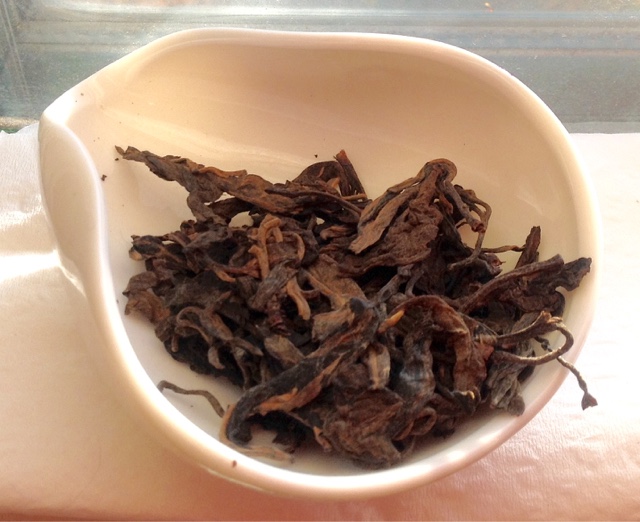
Fortunately, this tea has a beautiful dry storage and needed no airing when it arrived. I detected no storage odor at all on the dry tea which is rather unusual. Normally I plan to air out a Liu Bao for at least a couple of months before trying it, this one doesn’t need it and in fact the storage is so perfect I’d hate to lose any of the storage quality it has right now. Goody goody!

I should have weighed out my leaves, but like a pig I just scooped out a big dish full.

Two rinses and it could have perhaps benefitted from three, but with Liu Bao you need to be quick on those rinses because the tea gives itself in the first 4-5 steeps and you can end up wasting a drinkable cup with overzealous rinsing. Some funk goes with heicha territory which is part of the charm and if you’re a shou lover you won’t mind.


First steep a bit on the light side.
This type of heicha is partly oxidized tea, and then the heicha is pile fermented like shou giving the best of both black tea and shou puerh. It’s a nice break from shou. I’m not a fan of some of the very old 30 year+ heicha mainly because the ones I’ve sampled are so degraded and dirt/dust like. While Liu Bao may indeed be fantastic 30 years on, keeping that leaf quality is the challenge (don’t touch that basket). A lot of the older basket heicha can be faked too, as Varat recently pointed out when he evaluated an old basket Liu An. That faking is because everyone wants the leaf quality as well as the aging, so discovering an old basket with intact leaves is quite a find.


Second steep, darker now.
However, Malaysian dry storage can’t really be faked, while one might dispute age by a couple years, this flavor is either real or it isn’t present at all. This tea has it in spades and if you enjoy Malaysian stored sheng, then the same flavor is here at a fraction of the price.

So where’s the catch? Compared to other Guangxi Liu Bao I’ve had, the tea boasts some caffeine lift but is rather light overall. It’s not the heavy creamy brown thickness found in Three Cranes. Maybe this Liu Bao is autumn leaf. It doesn’t have the kick in the ass and heavy warming of something like the 1994 Sichuan Ya'an Kang Zuan Tibetan brick I reviewed last spring. This is Liu Bao I can serve my newbie friends, if I had any, and not worry they will run from my house screaming and never come back. I’m not sure my fictitious newbie friends would appreciate Malaysian storage flavor but I don’t have real friends, this tea is really all for me. I don’t see any point in storing this for another 10 years, I’m gonna drink it up right now.


2009 Anhua County Hunan heicha log
Today I also got my December white2tea club, and surprisingly found a 2009 Anhua Hunan heicha bamboo log, which looks suspiciously similar to the 2011 Zhu Xiang Ji (“Yu Lei Zhu Xiang Cha”). Except that my 2011 had the paper wrapping with the old lady on it and a plastic old style “wax” seal which I don’t think can be removed without untying the string, which on mine was white string and not hemp as this one is. Now, Anhua style heicha stored in small bamboo logs is a process used in Anhua County, so I don’t know for sure if the white2tea log is really the same farm as my 2011 but I’m tempted to think that it is. In any case, since I bought my 2011 for $21 and considered that a nice price for 200g, at the very least we know for sure that we got our club fee worth and perhaps more for an extra two years of age. Especially because white2tea isn't currently listing the log for sale for people who aren't in the tea club.


My 2011, you can see the "seal" on the bottom.
But I’m not going to try the new 2009 hemp-tied tea right now. I compared my own 2011 after the 2009 arrived with a natural bamboo smell, so the latter has some recent properly humid storage which makes me happy. However, I notice that my 2011 smells sweeter by comparison, and less like bamboo, because I’ve had it airing for more than six months. I don’t even have the best storage for my 2011, right now I’m using only a vintage 1950s aluminum kitchen canister which I feel guilty using, but since the tea is protected in the bamboo I’m not worried about the metal too much. So I’m going to add this log into the same canister.

I expect that social media will be full of tasters for the 2009 log, and I’ll warn you now to take any opinions in stride by people who haven’t aired it. I can’t blame anybody for diving in, but patient waiting means a sweeter and more fragrant cup!

Saturday, November 28, 2015

On Chinese Mandarin...it’s pu, silly.

Stuffed pu. Photo by createdrinkwrite.com

Oh, how tempting it is, looking at all the new citrus-stuffed puerh out there to buy, especially over the winter when local fresh veggies and fruits are difficult to find in my part of the world. Even worse are those massively plump grapefruits sitting in stores, reminding me of childhood boxes received from Texas and Florida where my father’s friends wintered and thought to send us the best of local citrus. I’m a huge lover of grapefruits, and haven’t had any now in more than two years.

No, you won’t be seeing any reviews of mandarin-stuffed puerh on my blog because alas I cannot have any. You’ll have to look elsewhere for lucky bloggers able to indulge at will. I’ve mentioned before that I cannot have this type of puerh, and since several people have asked for a specific explanation, I can clarify the medication interaction issue behind many citrus types which may hopefully inform others in the same non-citrus boat that I am.

I think most people are familiar with grapefruit juice as a caution for many medications. The issue that is very difficult to sort out when assessing other types of citrus is twofold: 1) the taxonomy of citrus fruit is not entirely clear, and 2) the specific piece of fruit staring you in the face may not be terribly clear either. Let’s start with taxonomy.

While citrus fruit in general is one of the oldest foods that humankind consumed, citrus has evolved, morphed, grafted and traveled its way all over the world, changing as it goes. The entire taxonomy of citrus and hybrids is a complicated business, and while a whole branch of taxonomy is dedicated to it. Complicated means something like this:


wut? (deviant art)
Even a scholar who has the potential to sort out this mess won’t have enough funds to do wide studies to work out every single type of fruit available. And, if you live in California or Arizona or some other southern state, you might have citrus in your own backyard that grew there well before you moved in.

Several fruits are on a parallel with each other. Oranges, lemons, grapefruits and pomelos appear to go back to original strains somewhere long in time in southeast Asia. Mandarin oranges are parallel to pomelo strains. Original mandarins are actually green skinned and not the orange skinned ones you find in the stores nowadays to eat around the holiday season. The Xinhua Mandarin grown in Yunnan may well have a number of varietals, but its ancestral relative is likely the pomelo or some grapefruit/pomelo hybrid.


I dunno what all these are, but Ruby takes my love to town. (www.cell.com)
These fruits contain what are called furanocoumarines, which are the culprits in citrus causing problems with drug interactions. “Furanocoumarin” sounds a lot like the blood thinner “coumadin,” and for a reason! Now, fruits vary a whole lot in the amount of furanocoumarin. Some fruits have a concentrated amount in the juice, some may have concentrations in the white pulp. One grapefruit or pomelo may vary a great deal from another grapefruit or pomelo. See the possibilities for a high degree of variability, and why it isn’t remotely possible to test every single piece of fruit?

Calcium channel blocker medications rely on the same enzymes for absorption and elimination that furanocoumarins love to bind with. Specifically, the enzyme known as CYP3A4 and located in the intestinal tract is responsible for slowly digesting and eliminating a calcium channel blocker medication. As with most medications, only a small amount of medicine in a pill you swallow actually gets absorbed and used by your body. Most of the medicine is removed and excreted, usually via urine at some point. Hence why we have issues with our water supplies, people are peeing out medications constantly and we have no idea how many of them are in tap water these days. But as for medication efficacy, pills are designed with elimination in mind, a dosage is based on how much your body will actually “get” once the absorption and elimination process is complete. Pill dosages rely on knowledge of how the body will get rid of most of the medicine and keep only the amount your body weight requires for the desired effect.

Unfortunately, our citrus fruits come along and interfere with this process by binding to the enzymes needed to process and eliminate most of the medicine. For example, I take Nifedipine, a calcium channel blocker designed to lower my blood pressure. I take a 24 hour extended release form of the pill. It goes into my intestine, then hangs on to the side of the intestine and sits there while the enzymes slowly work on the pill. Some of the medicine gets absorbed into my blood stream via the intestinal wall, this is the medicine I actually want to get. The rest of the pill gets worked on by the enzyme CYP3A4 and excreted. Let’s see a Pac Man version of what happens with my Nifedipine pill when I eat a citrus fruit containing furanocoumarin.

My gut on overstuffed Pu. The blue dots are CYP3A4 enzymes
In this cartoon, you can see that the citrus is binding up all the enzymes, leaving none for my nfd Nifedipine pill. That forces it to dissolve in the tract, going nowhere except into my blood stream since it is stuck in its pill state. This means that too much medicine hangs on in my body, and I can get a lethal dose of the medicine as a result. My blood pressure can fall so low as to be fatal. Even worse, this effect lasts for days. Up to five days later, because the citrus removed so much of the enzyme that my body will need nearly a week to make more. Now if I put yet another pill tomorrow into this situation, I can expect never to leave my bed again. You can see from the Pac Man who is going to win and it isn't my pill. 

But you might be thinking, what effect can a small piece of dried pomelo or mandarin possibly have? A small piece broken into a tea cup or a bit of juice in the tea surely cannot have that much of an effect. As a matter of fact, it can. First off, I don’t know how much furanocoumarin is in a particular piece of fruit. American doctors are working with information gained from readily available citrus to American consumers, such as Florida plantation citrus, or maybe Texas citrus. But this information relies on the product manufacturer to be honest. In general, orange juice might be okay, but how do I know that the maker didn’t sneak in some cheap grapefruit juice or pomelo as filler instead of 100% sweet and juicy navel oranges? I don’t know that.

If you live in the UK, your doctor may well tell you to avoid citrus altogether if you are taking a calcium channel blocker. And if you think “well this won’t be me,” think again. If you have African Caribbean descent, calcium channel blockers are an even more effective heart and blood pressure group of medications for you than for someone else, and a doctor will consider these first when you show up with your BP on the high side. 

I would love to ditch this Nifedipine and have a huge glass of grapefruit juice right now. In fact, I won’t allow any in the house because I can’t keep away from it. My mouth waters thinking about it. Even more difficult for me are the tempting photos of stuffed puerh teas. I have that little voice inside me saying “just a teensy, weensy little bit.” I rarely ignore that little voice. I even tried to rationalize saving money for tea by taking Nifedipine only once a week and drinking grapefruit juice on the other days. Nifedipine ain’t cheap. In fact it costs more than the damned stuffed puerhs.

I can imagine what my doctor might say, though, when she hears the idea of a Nifedipine/citrus cocktail and I know where that conversation will go, out the door along with my ass. As it is, she doesn’t know how much tea I drink. She knows the reading on the blood pressure monitor when I go into her office, and I know that look of satisfaction on her face when she determines she knows her medicine well. And she’s been a missionary doctor in Africa and takes no crap from this old nun, which is why I keep her. And why I take my pill as prescribed and avoid any funny business. This is the point when guessing on that citrus puerh is just not worth it for me.

So, you all enjoy your overstuffed puerh! 

I’ll be over here. By myself. Taking my pill.


Sunday, November 22, 2015

Black and Blue Marks


Black and Blue Marks
Over the past week or so I’ve received a number of messages from people wondering where I’ve been and asking me to start writing more often. Attempting to do that now, but I want to put aside any concerns for my health, I’m doing fine at the moment. Lately I’ve been busy with a new job I’ve taken on. For several weeks, I couldn’t find the time and space to even drink tea. Moments like that never last long for me, and I’m back on the sauce with renewed interest. Unfortunately the job I’ve taken on, however, has left me rather devoid of humor lately which is why my writing is suffering.

My job involves managing Medicaid benefits and services for people with disabilities and frail elderly persons, and because of my long experience and credentials, the company tossed me some extremely difficult situations that one hardly can imagine in this day and age. For example, I am working for a deaf woman with almost no education and very limited signing, and even with ample funding, few resources exist in rural areas to assist in helping her become more independent in the community. And then I have a woman with rotting limbs, literally maggots eating her flesh and she doesn’t care enough for herself to get healed. Worst of all, another woman’s boyfriend has beaten her newborn baby almost to death, and I don’t know if the child will live. These situations are endlessly troubling, and while I can set aside time to drink some tea, I don’t have any humor at the moment to write with. All I have are black marks.

And one Blue Mark.

A couple of months ago, I got a sample of a 1990s Blue Mark tea in the mail from a Steepster friend, along with a few other favorites. He spoiled me with a big box, and now that cooler weather has arrived, the aged teas look mighty tasty. I’ve had my eye on this teacake ever since white2tea offered it back in 2014, I think. I see the Blue Mark is still available for purchase but for some reason my eyesight experienced a moment of blindness when trying to check out the price. My eye doctor confirmed the issue last week and told me “You can’t see!” and he ordered me some new glasses. I have to wait two weeks for my new Coke bottle lenses to arrive. So right now, ahem, I can’t possibly read the price tag for the 1997 Blue Mark and you’ll need to check it out for yourself.

I opened up the precious sample and dumped it into my presentation dish about two weeks ago. I weighed it out and now can’t remember what it weighed, maybe 8 grams. Oh, I saved a photo of the sample, so that tells me 7.5g, not bad for an eyeballing. I meant to start on this tea but then all my gaiwans had other teas waiting to be steeped out and I couldn’t possibly throw any of them away. Now with a gaiwan available, I pour two boiling water rinses and start in.


My friend drew a face only on this tea, with heart eyes.
This puerh tea has had some humid storage, but this type of storage is more what we call “natural storage.” Anyone living in a drier climate will smell a bit of mustiness like old books, but it is not the true wet compost-type storage that melts and fuses the leaves in the cake.  Not “on purpose” wet storage, but rather ordinary climate mild humidity over time. I doubt most people living in humid weather could notice this humidity, probably everything smells like this tea. But the musty is a little noticeable, and the effect of browning on the leaves quite noticeable. At first sniff, I wonder how long it has been since I had an aged tea with a bit of humidity. All summer long I’ve been drinking fresh puerh tea almost exclusively for the cooling and diuretic effects. Only recently the weather here has cooled to the point where I’m now setting aside my fresher teas and turning my attention to oolong and aged puerh.


Purty.
The Blue Mark brews up crystal clear, and this is pure money, in a cup of topaz liquor with a ruby ring. None of the signs of bad wet storage, thick opaque brew or too much dust or swirling clouds of god only knows what. This tea displays aged results we aspire to with storage, obtaining this kind of clarity is the goal of goals. You can have the right wrapper, the right leaf, the best climate and storage solution and even then won’t know until 15 years on if you got it right.


Second steep after two rinses.
This tea is alive with sweetness and energy in the mouth, bits of florals and spices and honey, vanilla and root beer. I can see some big leaves in the gaiwan, so it’s not all about buying tea with mostly buds, these bigger leaves prove a mix of leaf is what we want for a good aging tea. Lots of humid teas out there to buy, but can I find any with liveliness left? Or has the tea wilted too much under the dampness leaving only graphite and a bit of wood flavor?


No filter, steep 8. Clarity = $$$
This tea is a long steeper. Other folks who have tried it report days of steeping. With older, browner teas, I have noticed that giving the leaf a rest overnight or for at least a few hours between steeps lets the water soak in and release more from the leaf. That tea spent nearly 20 years getting to this point, it needs time to stretch out and open again.


Big leaves, with browning of naturally humid climates.
Regardless if our teas are stored more wet or dry, this Blue Mark is an excellent benchmark to test out an example of exceptional storage. With it, I can compare my own teas: are my teas clear or cloudy? Do they taste sweet or merely neutral like wood or paper? Can I find flavors like fruits or spices in addition to the sweetness, indicating depth and dimension? If I can get results like this Blue Mark has, naturally I will become rich.

This tea is sold by the gram as well as the entire cake. I hope you have the chance to at least pick up a few grams of this tea to give yourself an idea of how an exceptionally stored tea looks and tastes. Thanks to my Steepster friend, I've had a chance to give this a try and I expect this will continue to steep out past the two days I've been drinking so far. Teas like this are not fussy to brew, one doesn’t need to mess with parameters to coax a decent cup, puerh tea with perfect storage will give it no matter how you brew. I’ve learned from this one that while leaf and wrapper may be important variables, my tea is only as good as my storage and maybe a few lucky fingers crossed.

Requiescat in Pace.

Sunday, November 15, 2015

Put Up Wet

This year I’ve certainly enjoyed all of the 2015 puerh offerings I can cram into a gaiwan, working in between my budget and generous tea pals sending me samples of their favorites.  I seem to have developed a well-deserved reputation of the “gal who will drink anything for the sake of the blog.” However, I still very much feel that anything is better than what I drank for tea back in the previous century. In fact I have the same feeling about video games today, grateful for the incredible things I can play now because it ain’t a sprite running through trees, and I can tune out young people like my son complaining of pop-in as mere whiners. Of course an overall feeling of gratitude for any type of tea might render me a less than discriminating reviewer, but I’m okay with that. You can find picky in a million forums if that is what you require. Oddly enough, though, when I do get somewhat picky in my blog, a rare occasion, I need an umbrella aka email filter for the ensuing shit storm.

But after gratefully tasting a lot of teas this year, I don’t feel I’m too picky to say the tea is put up wet. A lot of vendors have told me that most of their buyers are drinking their teas right away instead of buying for the long haul, and so the western market focus may have shifted in the near and long term toward tea we drink right now as opposed to storing for later. And while I might be one of those short term buyers, given the few years I’ve got left to enjoy tea, I’m aware of the fact that an awful lot of puerh buyers sit back quietly acquiring tea for the long haul and aren’t posting their latest yum-yums on social media. And these folks have got to be thinking 2015 is one wet year. For unless you know a vendor who got in to Yunnan early, before the early April freak rains, and got their teas done in March, such as Crimson Lotus or Chawangshop, you’re probably storing up a few teas hoping they dry out and settle down before even thinking of trying them. And if you’re buying for the long haul, aside from a possible experimental tea like white2tea’s 72 Hours, long haul buyers might be sitting out 2015 altogether.

Looking back now at the drought years of 2013-2014, long haul buyers with a decent storage set-up might think these years are a bit more attractive than before. Especially if you look at what you can get now in aged teas, so many years are simply sold out. Last year I didn’t have much trouble finding a selection of ’01-’04, but I’m noticing just lately these years are getting tougher to find. What remains is a smattering of late ‘90s teas that have a reputation of being rather flat, perhaps just not aged in an ideal way, or perhaps the leaf wasn’t that great to begin with. The few tea cakes that are “known” collector buys like the last good years of ‘90s CNNP are crazy expensive. Then we find less and less available until the over-picked years 2005-2008, everyone seems to have a supply of these teas. Until something sticks out 10 years on, likely those years will still carry a bad rap associated with the puerh price bust.

Years 2009 and 2011 are tough to find decent sheng puerh available to buy anymore, though you can still find plenty of shou cakes, but even the decent Liu Bao from those years is already gone too. I know for a fact that the long haulers in puerh have already given up on sheng and are trying to dig up some overlooked Liu Bao or decent oolong. For others still at it, the only way I can see to go now is to take a look at the drought years 2013-2014 again while the teas are plentiful and still with reasonable prices.

You might say, well Cwyn, how do you know anything about 2013-14, because we don’t know anything about storage in the west and nobody outside of Malaysia can possibly store tea and expect anything decent from it? But you don’t know, either. No one does. So unless you have a buddy-buddy line to someone in Malaysia then you are in as good a position as anyone else to buy tea and store it yourself. Ten years from now we will see who is sitting on a good stash and decide then. I’m not convinced now that teas stored in the west bought from years 2004-2008 represent anywhere near a definitive opinion on western storage. And I don’t care who says otherwise, because I don’t see a decent sample stash of leaf that isn’t low grade factory crap. I am absolutely certain that the teas we can acquire in the west from the past two years are better quality leaf, period. So with sheng puerh buying and storage, in the west it is still anybody’s game.

So anyone new to the hobby who doesn’t know what to buy should feel as confident as anyone else at this juncture. The Newb and Long Hauler alike can look at the 2013-14 puerh teas in the $20-100 price range and make the same crapshoot with the same odds all around. At this point, one man’s unplugged refrigerator storage is as good as another man’s until we see otherwise, and in the end the whole decision may boil down to factors we simply cannot predict at the moment, except that leaf matters. And in this sense, I think the less rainy years of 2013-14 represent the best predictive variable that the long-hauler has right now with tea that is more concentrated and less wet when starting the storage process.

My slightly damaged wrapper cake.
My most recent jump-in was when Scott at Yunnan Sourcing put some 2014 Ai Lao mountain cakes up for sale with slightly damaged wrappers.To be honest, I’m certain I wouldn’t have noticed this tea but for the special due to the few damaged wrapper cakes. However, this tea has a bit of a storage track record already.

My wrappers end up like this anyway, it seems, wedged in the fridge.
Scott at Yunnan Sourcing confirmed that he has sold this blend from 2009 onward, and you can certainly purchase any of the past three years to compare them. This cake is a “blend” of varietals, and I thought I spotted the Taliensis varietal after having tried the 2013 Jinggu Taliensis over the summer (remember when my old mother in law was visiting?). The fuzzy buds are a giveaway and used here to add body to the tea, though Scott didn't confirm this observation on my part. Jingdong County borders the Wuliang region where Yunnan Sourcing gets a number of other cakes made. Both regions have teas which are characterized as strongly floral and fruity. This Ai Lao cake is no exception, the "white camellia" aroma sets it apart from Menghai teas.


Can you spot a red tea seed pod?
One of the main criticisms of floral/fruity teas from these areas is that they don’t hold up with age, that they are more “drink now” teas. But I wonder where this idea came from, is it likely that this idea came from a more humid climate, where teas will need to be strongly bitter to withstand the effects of high heat humidity? Or, do we know how the teas are stored at all? Are there Wuliang region teas stored in the west that have not been properly stored, with attention paid to humidity in drier regions? I really question such blanket generalizations when I read that people are indeed storing these teas in the west with a decent set up. 


The fuzzy buds and bits of older leaf show the blend used.
You can read reviews of the Ai Lao cakes on Steepster and see people like mrmopar, with his decent set up, who is storing the 2011 Ai Lao and he is not losing the floral and fruity quality of the tea at all. This tea can be purchased from the Yunnan Sourcing US site for $32, or $27 if you don't mind a damaged wrapper. MrMopar would have bought his back in 2011 for around $17. This tea costs more now, but not that much. And certainly worth the $27 for a bit more education and 400g worth of experimentation on my part. Worth the effort too to buy a cake that others have purchased and see how mine will stack up against the storage of someone else, and start to develop a record of conversation and data.


Certificate of pesticide testing is in the wrapper.
The 2014 version is plenty strong, in my opinion, at least in the astringency department and I pushed 11 grams here to make sure I could taste how bitter this is in addition to the very nice floral notes. I noticed that after two cups of 11 grams my heart rate increased dramatically and I backed off continuing that first session until later on. After a half hour or so, my heart rate slowed and I had a strong salivation effect in my mouth. This tea is plenty strong. Of course if you want to store Bulang and get a very bitter tea sweet by pushing humidity, then by all means. But why would anyone want to push a nice floral tea, when simply providing a decent storage of 60-70% humidity will keep the cake as it is, and age it more slowly to work out the astringency and bitterness without destroying the subtleties in the leaf with constant, intense basement-type  humidity?


Such pretty leaf.

Perhaps different leaf is appropriate for different climates. We need bitter teas for places like Hong Kong and Thailand where high humidity works on the tea and retains flavor. More delicate teas perhaps won’t hold up to such treatment. This is not to say that a highly humid climate is “better” overall. Instead, it seems like common sense to me to consider each tea for what it is, and give each tea the treatment that is required.

Thick first steep, not much char in the gaiwan.
Fuzz on the buds will turn to dust when removing tea,
and show in the cup as a bit cloudy.
So, check your teas that you bought this year and see if you find additional water in the leaf and then taste what happens over the course of the year. Revisiting 2013-2014 for strong age-r’s is worth doing now while the prices are favorable and these teas are now rested. Many people are setting up storage solutions, and taking each tea into consideration is one factor when determining how to store the tea. I am going to consider purchasing a few more teas that my friends have bought to continue a longer term conversation about storage and add to the notes we already have.

Sunday, October 18, 2015

2015 WTuhaoF*k and where’s she been?


Yah, okay, I’ve been off the tea radar lately, but as usual it is not my fault. This is the sort of thing that happens after doing tea sessions in public, as I did two weeks ago at the Wisconsin Fermentation Fest. You see, the folks who run this festival told me to prepare for 50 people, and so naturally I did. Not wanting to skimp on the tea for the fine festival-ers paying the $25 big ones for the session, I gong fu brewed using western teapots, well maybe they were coffee servers actually. I think I brewed 30-50g of tea per pot. In fact I’m pretty sure that’s the case but I didn’t think to measure the tea beforehand. I just know that two weeks later I’m still steeping out the same tea, which is why I haven’t had anything new to post.

Now, if tea blogger extraordinaire Nicole Martin is correct and Tea Education is “broken,” Old Cwyn is here to break it some more. One of the most important things a Tea Sommelier learns is how to gong fu brew small gaiwans and pour them neatly into thimble sized cups. I have no chance in hell of learning that skill, and as a matter of fact I burned at least three people during my tea session. I might have to forfeit my fee for the legalities that are sure to result, but at least nobody complained about the tea.

The first tea I served was 2015 Poundcake from white2tea. In fact, white2tea donated 2 kilos of shou balls for the Wisconsinites attending my class, but we’ll get to that in a bit. To start, I wanted to serve a very fresh tea so people could taste what puerh tea is like in the raw. I did bring along the 2015 Menghai ‘Shroom but I didn’t want to bomb the newbs with gut-wrenching bitterness, and that tactic paid off. For the 2015 Poundcake ended up as the class favorite by a large margin. However, a couple of tea heads attended the class and their votes and subsequent panhandling of my more aged teas indicated wise and learned tastes on their part.

Next, I served white2tea’s 2005 Naka, and if you’ve read my blog then you know that this tea is one of my favorites and a personal hoarding project of mine. Tiny leaves of the good stuff, and my aging has sweetened up the tea at ten years, but still retains some green promise left to go. I used at least 40g in a bowling ball size teapot. Naturally I’m still drinking up these leaves two weeks later, and that’s after giving some away and filling a few thermoses for participants on their drive home. I know for sure one tea head is still alive because I got an email a few days later saying he’s still steeping the Naka at 10 pots himself.

My personal favorite served next was the 1998 Yiwu, also from white2tea. It’s long sold out, so no need to run over there to look. On that festival Sunday as I pre-rinsed all the leaves so I didn’t have to bother doing so during the class, I thought “gosh I’m tired and don’t feel like doing this.” But the moment I packed the 1998 Yiwu into a large Tetsubin strainer and rinsed it, why the smell of those leaves, all spicy and sweet got me in the mood for some serious tea drinking. Now our weather had included some mild and muggy days prior to the class, following a muggy hot summer, and the 1998 Yiwu tasted prime, spicy and woody and sweet, and damn good. Like a fine cognac. I paid nearly $400 or so for that tea and it is worth every penny. This tea is reason enough alone to never look at Taobao ever again.

However, I didn’t want to deprive the Wisconsin Fermentation Fest of Taobao, which would be remiss and certainly indicative that Tea Education has truly gone to the snobby pigs. So for the Shou finisher I served up dzpuer’s 2013 500g shou brick. No not all 500 g, but yessir I served it so strong that any water sitting on those leaves turned to gelatin without carefully watching and I had to pour some of that gelatin out when people wanted a bit more after the class, in order to add fresh boiling water. One doesn’t need a fine shou to balance out a sheng session, an ordinary one will suit. Instead, I sent people home with the samples of white2tea’s much finer shou balls and some raw Yiwu mini tuos to brew at home. I’m not gonna say where I got the Yiwu tuos, but rest assured the gift samples are education in a bag. The best part of the class was the after-session, when three tea heads stayed to guzzle as much tea as we could drink. One guy begged off some unbrewed 1998 Yiwu to impress a Chinese colleague at work who is a puerh drinker. I couldn’t say no to the opportunity to outdo one’s colleague with tea cred, and forked over a good 15g, or so I hoped.

After the class I had to clean up the room, and I’d made a huge mess. The class took place in a closed up clothing shop in an old 1800s building, and I had to do tea on a white plastic table. Stained up the entire table with tea rings and puddles, and cleaning those off took a good half hour with me and my assistant scrubbing away with bleach cleanser. Also I picked up tea leaves from the floor and a few dead flies I’d killed during the class with a flat paint brush. Once finished with all that I got to drive home in my beater car over the bluffs and high hills, when just the day before a friend of mine did a brake job on my car and hadn’t bled the air out of the lines and so I had no brakes on the entire 50 mile round trip. He had threatened to kill me in July and just about made good on that promise.

Big props to the Wormfarm Institute for arranging the Wisconsin Fermentation Fest, and for sending me a real tea head as an assistant, the organizing all around was top notch. But being the messy woman I am, I kinda doubt I’ll be invited back again anytime soon. Next time they’ll probably be looking for one of you for-real Tea Sommeliers who can pour a fine thimble. Just remember that Tea Education is going to Hell when you drink your thimble and pine after the days when Cwyn the Pu Pig showed how it’s done with 50g of fine puerh.

While I’m still drinking out the 2005 Naka two weeks later, (and no way will I be throwing those leaves until they are done), none of this prevents me from trying the 2015 white2tea Tuhao as F*k, or whatever it is called. Apparently the name of this tea comes from some sort of hip hop album, a reference which escapes me, but at least doesn’t carry the heavy juju of the Colbert Holland moniker cake. I got a sample of this tea from a friend who purchased a larger amount, lucky me. He hoped I might write about it, so here goes.

Sample baggie from a friend

The rap I’ve heard about all summer with the Tuhao is how “aggressive” the qi is, which means I might have a chance of avoiding a nap after trying it. My friend sent me a beautiful sample and obviously took great care when separating some leaves to send, as they are beautifully intact. I managed to eyeball 7g and confirmed my guesstimate at the electronic scale. Two rinses and a nice fresh tea smell brings some curiosity, as I’ve heard often the Tuhao has a “typical Menghai profile” and to me that usually means the acrid apricot of cheaper teas, but I’m getting the lighter grape notes rather than that sour orange we see all too often. My palate confirms the lighter flavor, though I’m steeping heavier than I expected, maybe only 75 ml or so.


7g loose
A lot of buds in the gaiwan, so I cannot discern if my sample is representative of the entire cake or if my friend kindly tried to carefully remove tea from the top of the cake in order to give me the best cup. This has a bit of the flavor of last year’s Last Thoughts, that fresh, fruity, bitter to sweet grape and less of the hay. Long in the throat and esophagus, I’m feeling this one going down and lingering like sweet baby aspirin. But most of white2teas have this juicy long throat characteristic this year.  I know that this is something TwoDog looks for in the leaf he selects.

A few cups in and I’m not finding this particularly aggressive. But then I’m the Pu Pig who just brewed up a whole pile of teas in coffee server size vessels. And I’m the old lady taking an ace inhibiter too and using my meds as an excuse to drink more rather than less. A bit more dissembling and thinking, and hey I know plenty of tea heads who start in on the Pu –bah early in the morning and are still at it well into the late evening, so any of those folks can easily enjoy the Tuhao without much fuss. Tuhao may not be a early morning tea, but easy enough to drink with a meal under the belt. I'll admit my meal an hour ago of eggplant parm and a bit of beef leaves my palate wanting fresh and light, so perhaps I'm missing out on deeper notes in the tea after such a heavy and sweet meal.

Third Steep
People have compared the Tuhao to the Bosch, but I think this is more a conversation about shopping, of which cake to buy if money only buys one or the other. Then the next issue is to compare traits for aging. What I’ve concluded about white2tea’s fresh cakes overall this year, as well as last year, is that I primarily would purchase any of these to drink now. White2tea has some of the most gorgeous fresh leaf, and the Tuhao is no exception.  I just think it’s a shame to tuck away any of white2tea’s fresh leaf, except perhaps the 72 Hours which is a proprietary blend from another tea blender and meant to be drunk at the 5 year mark. Now I’m not referring to the hoarder who must tuck away a beautiful cake, but if I’m going to spend the cash for any of the teas this year, I want to enjoy them now for the lovely leaves they contain. If I want something to age, I’ll buy an undrinkable gut bomb someplace else for a lot less. 

And that points to the real chatter going on around white2tea: I think people are talking about the teas for the wonderful experience we get drinking them fresh more so than for aging.

Fifth cup and the tea is getting a bit lighter, no doubt the loose leaf at the start gave me more punch in the first few brews. Still so fresh and light, a bit of summer into mid-autumn, the grape flavor holding consistent. Not tasting any reason here to want to tuck away this fresh leaf into storage with my older cakes. No, I’d peruse the older catalog teas on white2tea for something aged. In fact I’ve got a sample of the 1990s Blue Mark from the same friend, and I look forward to drinking that for a future post.

Finally, just a note about my reviews for people new to reading my blog: I primarily purchase the teas I review for myself. If I got a free sample from someone, I will say so. If the vendor gives me a sample, which I normally don’t solicit (why would I? I have too much tea already), I will say so. I do chat with tea vendors and mostly we talk about…tea. The vendors I chat with about tea aren’t trying to sell me anything and in fact tea pimps cut me off after awhile from buying tea for reasons I can’t discern and mostly stress over. I tend to buy full cakes rather than samples, and find vendor samples often dry out after a short time away from the original cake. If you can afford it, I suggest buying the full cake when possible and if you don’t like it, use it for swap currency with another tea head.

Til next time!